


Blog Categories
- African Incidents
- Atlantis Incidents
- Australian Incidents
- Belgian Incidents
- Bermuda Triangle Incidents
- Brazilian Incidents
- Canadian Incidents
- Chinese Incidents
- European Incidents
- France Incidents
- Ghosts
- Giants
- Italy Incidents
- Japanese Incidents
- Middle East Incidents
- Portugal Incidents
- Project Serpo
- Puerto Rico Incidents
- Russian Incidents
- Sasquatch
- Scandinavia Incidents
- Spanish Incidents
- UFOs
- United Kingdom Incidents
- United States Incidents
September 1904: UFO Sighting Over Stockton
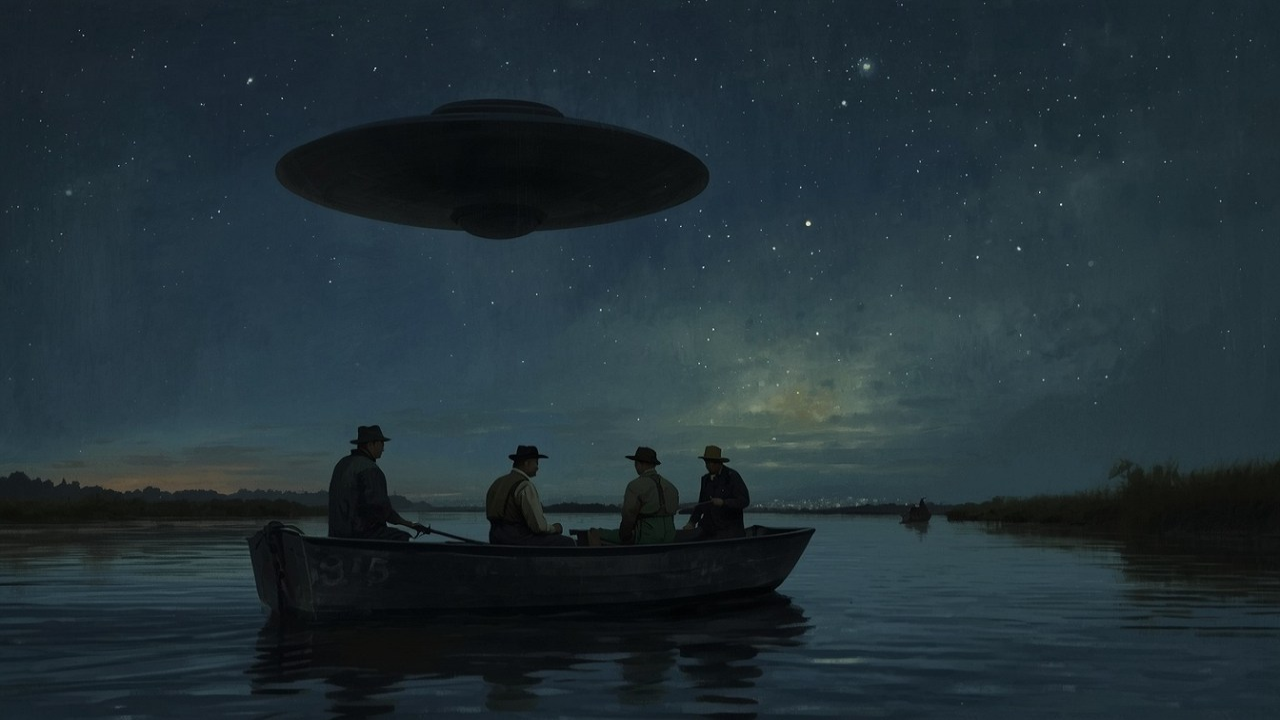
In the stillness of a late summer night in September 1904, four fishermen near Stockton, California, experienced an event that, though nearly forgotten in mainstream history, resonates today within the broader context of unexplained aerial phenomena. They described witnessing an oval-shaped object pass overhead—dark, silent, and vast enough to momentarily blot out the stars. What makes this account remarkable, even more than a century later, is not only the description of the object itself but the quiet ripple of awareness it represented at a time when manned flight had not yet taken hold of public consciousness.
Though rarely cited in modern UFO compilations compared to more sensational accounts, the Stockton incident carries subtle importance. At the time, aviation was in its infancy. The Wright brothers’ famed flight at Kitty Hawk would not occur until December 1903, and even then, few people in the general public knew or understood what controlled flight entailed. In this context, the fishermen’s report seems to exist outside of the technological imagination of their time. The idea of silent, low-flying, star-obscuring craft would have seemed alien in every sense of the word.
The Sighting
The four fishermen—whose names were never formally recorded—were plying their trade along one of the many inlets outside Stockton, a town already familiar to those following anomalous sightings due to its 1896 encounter with Colonel H.G. Shaw and Camille Spooner. On this particular night, the men were startled as a large, oval-shaped object passed overhead at a relatively low altitude. Descriptions suggest it was completely silent, moving with a slow, deliberate motion. One witness claimed the object had “blotted out the stars” momentarily, giving the impression of a flying shadow or dark presence. But what cemented the event in the memories of those present wasn’t just the shape or movement of the object—it was the faint sulfuric odor that lingered after it passed. The scent of sulfur, often described in folklore and later UFO reports, has traditionally been associated with either industrial or chemical processes—or in more superstitious interpretations, demonic or otherworldly entities. For these fishermen, it likely indicated something unnatural, though in 1904, the vocabulary to describe what they had seen was not yet fully developed. The report was submitted to a regional circular, likely a local or county paper with limited distribution. While it made for local conversation, it failed to reach the wider audience that the 1896 airship wave had garnered. This may have been due to multiple factors: the lack of physical interaction, the small number of witnesses, and the nation’s slow embrace of aviation. There simply wasn’t a framework yet to understand or even entertain the notion of aircraft, let alone unidentified ones.
The Cultural Context
To understand how such a sighting would have been interpreted in 1904, it’s important to consider the public’s perception of the sky and air travel at the time. Balloons had existed for decades, but their behavior was slow, erratic, and weather-dependent. Airships—such as dirigibles—were being theorized and tested in Europe but were far from public consciousness in rural California. This left most observers with no frame of reference to understand a silent, high-speed craft. At the time, supernatural or religious interpretations still held sway in rural and semi-rural American communities. A strange, unidentifiable object could just as easily be attributed to a spiritual omen, an atmospheric manifestation, or even a sign from God. However, unlike the more dramatic “alien” interpretation that came to define later 20th-century sightings, this incident seems to have faded into near silence shortly after it occurred. There were no reports of panic, no investigations, and no military inquiries—because such structures simply didn’t exist yet for handling this kind of phenomenon.
Public Impact and Legacy
Though the incident failed to stir a national or even state-level reaction at the time, its significance lies in its contribution to the early catalog of UFO sightings in America. Much like the 1896–1897 airship wave that had placed California at the epicenter of national attention, this sighting quietly added to the growing mosaic of unexplained events that would later become relevant when public and institutional interest in UFOs exploded in the 1940s and 1950s. In modern ufology, the Stockton 1904 incident is sometimes cited as an example of a “pre-aviation anomaly,” or an encounter that occurred before mankind’s technological capability could explain such objects. Because of its early date and the mechanical impossibilities associated with a silent, hovering, star-obscuring object, believers often cite it as further evidence that humans have long been interacting with forces or intelligences not of our world. Moreover, the sulfur smell reported by one of the fishermen mirrors details in later, better-documented cases. For example, the famous 1952 Flatwoods Monster incident in West Virginia also involved a sulfur-like stench. Similarly, multiple CE2 events across the decades have reported scorched earth, ozone smells, or chemical traces after UFO activity. These parallels, while circumstantial, suggest a possible continuity in phenomenon.
Modern Interpretation
Today, the Stockton incident may be understood through several lenses. From a skeptical viewpoint, one could attribute the report to misidentified natural phenomena: perhaps a meteor obscured by clouds or atmospheric lensing that distorted visible light. Others may argue that early experimental balloons or dirigibles, launched privately or by inventors, could explain the sighting—though no corroborating records have ever been found. For believers and researchers, however, the significance of the Stockton case is that it contributes to a broader pattern of early UFO events that occurred when the concept of “flying saucers” did not yet exist. The men had no incentive to fabricate a story for fame or gain—no alien craze had yet emerged, and the media environment did not reward such tales. Their report, relatively quiet and limited in scope, feels more like a personal account than a hoax. In addition, the report’s details—particularly the object’s shape, motion, silence, and residual smell—align well with characteristics reported in sightings across the 20th and 21st centuries. This continuity raises compelling questions. If these reports are genuine, then what technology could move silently, emit sulfuric traces, and appear decades before such machines were supposedly invented?
Conclusion
The 1904 Stockton UFO sighting stands as a quiet but enduring mystery in the historical timeline of aerial anomalies. Though overshadowed by the more dramatic encounters of later decades, it remains an important early thread in the tapestry of unidentified aerial phenomena in the United States. While lacking the theatricality of abduction accounts or the institutional response seen in post-World War II cases, this event offers a glimpse into a period when the skies were only beginning to capture humanity’s curiosity and fear. In an age before radar, before jets, and before public discourse on extraterrestrial life, four men on a quiet night bore witness to something far ahead of its time. Whether a product of unknown science, misunderstood nature, or something truly alien, the 1904 Stockton incident continues to raise more questions than it answers.