


Blog Categories
- African Incidents
- Atlantis Incidents
- Australian Incidents
- Belgian Incidents
- Bermuda Triangle Incidents
- Brazilian Incidents
- Canadian Incidents
- Chinese Incidents
- European Incidents
- France Incidents
- Ghosts
- Giants
- Italy Incidents
- Japanese Incidents
- Middle East Incidents
- Portugal Incidents
- Project Serpo
- Puerto Rico Incidents
- Russian Incidents
- Sasquatch
- Scandinavia Incidents
- Spanish Incidents
- UFOs
- United Kingdom Incidents
- United States Incidents
The 1904 Floating Orb of Fire Over Peterborough
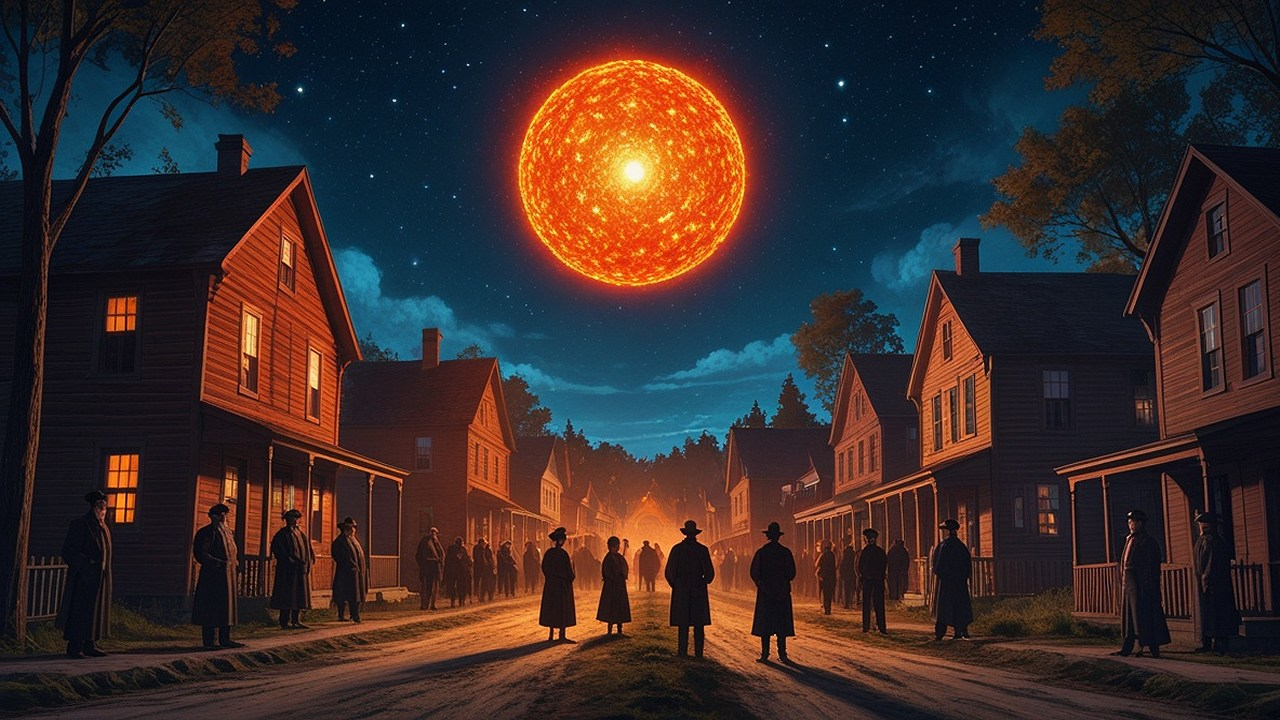
In the spring of 1904, more than a decade before the First World War and nearly 50 years before the modern UFO era officially began, residents of Peterborough, Ontario looked up into the Canadian night sky and saw something that should not have existed.
They saw a glowing orb of fire — bright, spherical, and completely silent — hovering motionless above the town. Then, without warning, it suddenly accelerated away at an extraordinary speed and vanished.
This wasn’t a meteor. It wasn’t a lantern. And it most certainly wasn’t an airplane — the Wright brothers had only achieved the first powered flight the year before, in 1903. What the people of Peterborough witnessed that night remains one of the earliest well-documented and credible anomalous aerial events in Canadian history.
Peterborough in 1904 was a growing but still modest town in Ontario, nestled along the Otonabee River. It was a place of lumber mills, small factories, and farming communities. Life moved at a slower pace. The night sky was dark and clear, unspoiled by modern light pollution. When something unusual appeared, it was impossible to ignore.
According to contemporary accounts, multiple residents — including a local constable — observed a luminous, spherical object hovering stationary in the sky. It was described as a “floating orb of fire” — bright enough to stand out clearly against the stars, yet maintaining a steady, controlled position for a noticeable period of time. This hovering behavior alone set it apart from any known natural celestial event.
Then came the most remarkable part. After remaining almost motionless, the orb suddenly accelerated away at tremendous speed and disappeared. Witnesses emphasized how quickly it departed — far faster than anything they had ever seen. There was no sound. No trail of debris. No gradual fading. It was simply there… and then it was gone.
The local newspaper, likely the Peterborough Examiner, attempted to explain the sighting as a meteor. But several eyewitnesses, including the constable, pushed back strongly. Meteors do not hover. They streak across the sky in seconds, burning up in the atmosphere. The object seen over Peterborough behaved in a way that was completely inconsistent with meteor dynamics. It showed control, deliberation, and performance that defied the scientific understanding of 1904.
This case is especially powerful because of its timing. Aviation was in its absolute infancy. The idea of a man-made flying machine capable of hovering and then rocketing away at high speed was science fiction. There were no drones, no experimental aircraft, and certainly no secret military programs that could explain what was seen. The witnesses had no cultural framework of “flying saucers” or “UFOs.” They simply saw something extraordinary and reported it honestly.
The credibility of the witnesses adds significant weight. A local constable — a figure of authority and trust in a small town — was among those who observed the orb. Law enforcement officers were trained to be observant and accurate in their reporting. Their involvement suggests this was not mass hysteria or exaggeration, but a genuine event that demanded attention.
When we place the 1904 Peterborough sighting in broader historical context, it becomes even more compelling. The early 1900s saw a surprising number of unexplained aerial phenomena across North America and Europe. In 1909, police officers in Peterborough, England (note the same town name) reported a cigar-shaped object in the sky. In Canada, the famous 1913 Great Meteor Procession involved multiple bright objects moving slowly in formation — behavior inconsistent with ordinary meteors. These early 20th-century cases form a bridge between ancient sky lore and the modern UFO era that exploded after 1947.
Natural explanations have been proposed, of course. Ball lightning is one candidate — a rare phenomenon that can appear as glowing spheres. However, ball lightning is typically short-lived, erratic, and does not demonstrate the controlled hovering followed by sudden high-speed acceleration described in Peterborough. Atmospheric mirages or unusual cloud formations also fail to match the witness testimony.
The 1904 event stands as a powerful example of what researchers now call a “nocturnal light” with structured characteristics. The spherical shape, self-luminosity, stationary hover, and instantaneous acceleration are all features that continue to appear in modern UAP reports, including those documented by military pilots and naval personnel in recent decades.
What makes this case historically important is its date. In 1904, humanity had barely entered the age of powered flight. The idea that advanced technology — whether human or otherwise — could be operating in our skies was almost unthinkable. Yet here we have credible witnesses describing exactly that. The Peterborough orb suggests that the phenomenon we now call UAP has been present for far longer than most people realize.
The media’s handling of the event is also telling. The local newspaper’s quick attribution to a meteor reflects a common pattern that continues to this day: the tendency to offer a conventional explanation even when it doesn’t fully fit the facts. This mismatch between official or media explanations and eyewitness testimony has been a recurring theme in UFO history for over a century.
For the people of Peterborough in 1904, the sighting must have been deeply memorable. In an era before radio, television, or the internet, unusual events in the sky were major communal experiences. Neighbors would have discussed it for weeks or months afterward. Some likely interpreted it through a religious lens — as a sign or omen. Others may have felt a quiet sense of wonder about what lay beyond their small town and limited understanding of the world.
Today, the 1904 Floating Orb of Fire deserves renewed attention. As governments around the world gradually acknowledge the reality of UAP, historical cases like this one provide crucial context. They show continuity. They demonstrate that ordinary people, with no agenda or preconceived notions about extraterrestrials, have been seeing similar things for well over a century.
The Peterborough case also challenges us to reconsider our assumptions about technological progress. If objects with these capabilities were being seen in 1904, then whatever is behind the modern UAP phenomenon may be far more advanced — and far older — than we currently understand.
The Floating Orb of Fire didn’t crash. It didn’t land. It didn’t communicate. It simply appeared, hovered, and departed at extraordinary speed — leaving wonder, questions, and a permanent record in the annals of Canadian history.
More than 120 years later, we’re still asking the same fundamental questions the people of Peterborough asked in 1904: What was that object? Where did it come from? And why was it here?
As we continue pushing for full disclosure in the 21st century, cases like the 1904 Peterborough sighting remind us that this mystery has deep roots. It didn’t begin with Roswell or Kenneth Arnold. It has been with us for a very long time.
The skies above us have never been empty. And perhaps, just perhaps, something has been watching — and occasionally revealing itself — for centuries.
In the spring of 1904, more than a decade before the First World War and nearly 50 years before the modern UFO era officially began, residents of Peterborough, Ontario looked up into the Canadian night sky and saw something that should not have existed.
They saw a glowing orb of fire — bright, spherical, and completely silent — hovering motionless above the town. Then, without warning, it suddenly accelerated away at an extraordinary speed and vanished.
This wasn’t a meteor. It wasn’t a lantern. And it most certainly wasn’t an airplane — the Wright brothers had only achieved the first powered flight the year before, in 1903. What the people of Peterborough witnessed that night remains one of the earliest well-documented and credible anomalous aerial events in Canadian history.
Peterborough in 1904 was a growing but still modest town in Ontario, nestled along the Otonabee River. It was a place of lumber mills, small factories, and farming communities. Life moved at a slower pace. The night sky was dark and clear, unspoiled by modern light pollution. When something unusual appeared, it was impossible to ignore.
According to contemporary accounts, multiple residents — including a local constable — observed a luminous, spherical object hovering stationary in the sky. It was described as a “floating orb of fire” — bright enough to stand out clearly against the stars, yet maintaining a steady, controlled position for a noticeable period of time. This hovering behavior alone set it apart from any known natural celestial event.
Then came the most remarkable part. After remaining almost motionless, the orb suddenly accelerated away at tremendous speed and disappeared. Witnesses emphasized how quickly it departed — far faster than anything they had ever seen. There was no sound. No trail of debris. No gradual fading. It was simply there… and then it was gone.
The local newspaper, likely the Peterborough Examiner, attempted to explain the sighting as a meteor. But several eyewitnesses, including the constable, pushed back strongly. Meteors do not hover. They streak across the sky in seconds, burning up in the atmosphere. The object seen over Peterborough behaved in a way that was completely inconsistent with meteor dynamics. It showed control, deliberation, and performance that defied the scientific understanding of 1904.
This case is especially powerful because of its timing. Aviation was in its absolute infancy. The idea of a man-made flying machine capable of hovering and then rocketing away at high speed was science fiction. There were no drones, no experimental aircraft, and certainly no secret military programs that could explain what was seen. The witnesses had no cultural framework of “flying saucers” or “UFOs.” They simply saw something extraordinary and reported it honestly.
The credibility of the witnesses adds significant weight. A local constable — a figure of authority and trust in a small town — was among those who observed the orb. Law enforcement officers were trained to be observant and accurate in their reporting. Their involvement suggests this was not mass hysteria or exaggeration, but a genuine event that demanded attention.
When we place the 1904 Peterborough sighting in broader historical context, it becomes even more compelling. The early 1900s saw a surprising number of unexplained aerial phenomena across North America and Europe. In 1909, police officers in Peterborough, England (note the same town name) reported a cigar-shaped object in the sky. In Canada, the famous 1913 Great Meteor Procession involved multiple bright objects moving slowly in formation — behavior inconsistent with ordinary meteors. These early 20th-century cases form a bridge between ancient sky lore and the modern UFO era that exploded after 1947.
Natural explanations have been proposed, of course. Ball lightning is one candidate — a rare phenomenon that can appear as glowing spheres. However, ball lightning is typically short-lived, erratic, and does not demonstrate the controlled hovering followed by sudden high-speed acceleration described in Peterborough. Atmospheric mirages or unusual cloud formations also fail to match the witness testimony.
The 1904 event stands as a powerful example of what researchers now call a “nocturnal light” with structured characteristics. The spherical shape, self-luminosity, stationary hover, and instantaneous acceleration are all features that continue to appear in modern UAP reports, including those documented by military pilots and naval personnel in recent decades.
What makes this case historically important is its date. In 1904, humanity had barely entered the age of powered flight. The idea that advanced technology — whether human or otherwise — could be operating in our skies was almost unthinkable. Yet here we have credible witnesses describing exactly that. The Peterborough orb suggests that the phenomenon we now call UAP has been present for far longer than most people realize.
The media’s handling of the event is also telling. The local newspaper’s quick attribution to a meteor reflects a common pattern that continues to this day: the tendency to offer a conventional explanation even when it doesn’t fully fit the facts. This mismatch between official or media explanations and eyewitness testimony has been a recurring theme in UFO history for over a century.
For the people of Peterborough in 1904, the sighting must have been deeply memorable. In an era before radio, television, or the internet, unusual events in the sky were major communal experiences. Neighbors would have discussed it for weeks or months afterward. Some likely interpreted it through a religious lens — as a sign or omen. Others may have felt a quiet sense of wonder about what lay beyond their small town and limited understanding of the world.
Today, the 1904 Floating Orb of Fire deserves renewed attention. As governments around the world gradually acknowledge the reality of UAP, historical cases like this one provide crucial context. They show continuity. They demonstrate that ordinary people, with no agenda or preconceived notions about extraterrestrials, have been seeing similar things for well over a century.
The Peterborough case also challenges us to reconsider our assumptions about technological progress. If objects with these capabilities were being seen in 1904, then whatever is behind the modern UAP phenomenon may be far more advanced — and far older — than we currently understand.
The Floating Orb of Fire didn’t crash. It didn’t land. It didn’t communicate. It simply appeared, hovered, and departed at extraordinary speed — leaving wonder, questions, and a permanent record in the annals of Canadian history.
More than 120 years later, we’re still asking the same fundamental questions the people of Peterborough asked in 1904: What was that object? Where did it come from? And why was it here?
As we continue pushing for full disclosure in the 21st century, cases like the 1904 Peterborough sighting remind us that this mystery has deep roots. It didn’t begin with Roswell or Kenneth Arnold. It has been with us for a very long time.
The skies above us have never been empty. And perhaps, just perhaps, something has been watching — and occasionally revealing itself — for centuries.