


Blog Categories
- African Incidents
- Atlantis Incidents
- Australian Incidents
- Belgian Incidents
- Bermuda Triangle Incidents
- Brazilian Incidents
- Canadian Incidents
- Chinese Incidents
- European Incidents
- France Incidents
- Ghosts
- Giants
- Italy Incidents
- Japanese Incidents
- Middle East Incidents
- Portugal Incidents
- Project Serpo
- Puerto Rico Incidents
- Russian Incidents
- Sasquatch
- Scandinavia Incidents
- Spanish Incidents
- UFOs
- United Kingdom Incidents
- United States Incidents
The 1909 Rocky Ford Report and Its Legacy
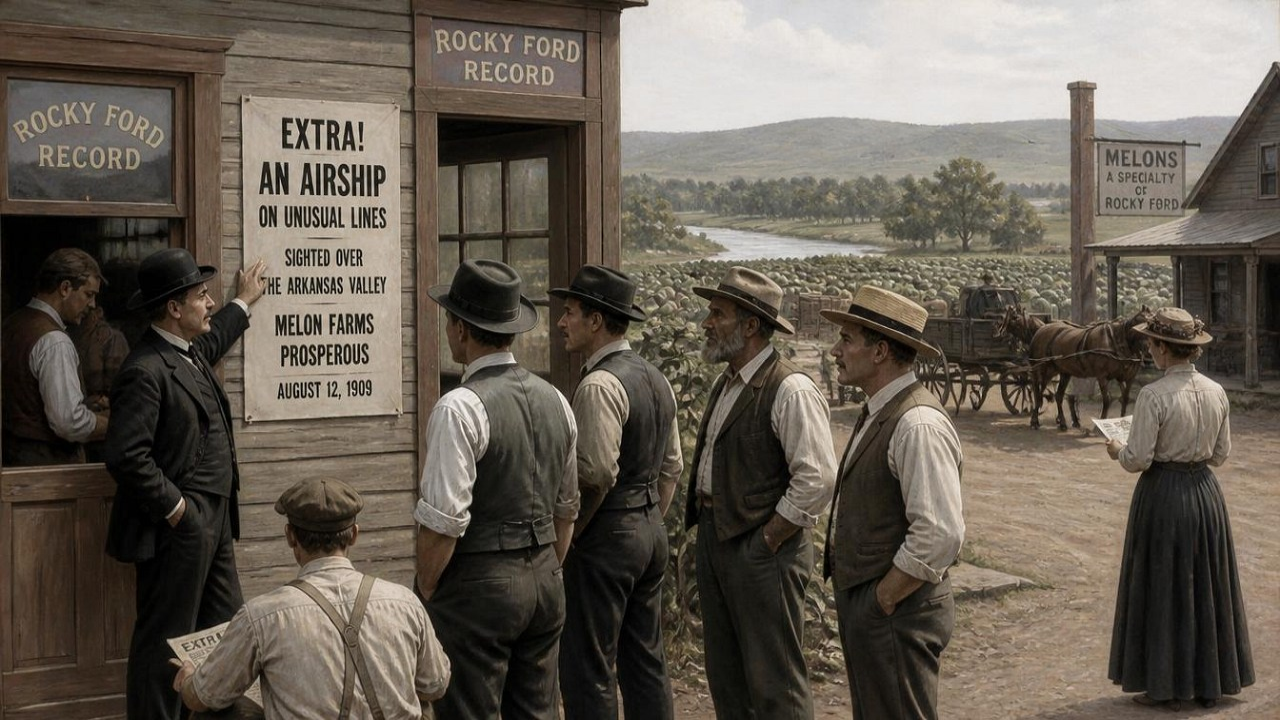
In August 1909, the small farming town of Rocky Ford, Colorado, became a temporary stage for one of the curious airship reports that punctuated the state’s early twentieth-century press. A local newspaper printed an item describing an “airship on unusual lines,” part of a handful of local sightings and notices in Colorado that year. Though brief and couched in the playful or speculative tone typical of the period, the Rocky Ford report captures a fascinating intersection of rural life, national aviation excitement, and the enduring mystery of unidentified aerial phenomena.
While not as famous as the nationwide airship wave of 1896–97, the 1909 reports in Colorado—including those from Rocky Ford, Summit County, and Denver—demonstrate the persistence of aerial curiosity in the public imagination. Examining the Rocky Ford case allows us to consider not only what the people of the Arkansas Valley thought they might have seen, but also how newspapers framed such events, how communities reacted, and how later generations interpret these fleeting notices.
The Local Setting: Rocky Ford in 1909
Rocky Ford in 1909 was a modest agricultural community in southeastern Colorado. Known primarily for its melon farms, it sat along the Arkansas River and was tied closely to the rhythms of farm life and railroad trade. Aviation was hardly a local reality; the town had no airfields and little exposure to the experimental aircraft being developed on the coasts or in Europe. Yet even in a town like Rocky Ford, aviation was a subject of curiosity. Newspapers carried syndicated stories of the Wright brothers’ demonstrations and of Count Zeppelin’s massive dirigibles crossing German skies. Farmers who spent long hours outdoors had reason to look up at the sky, and the notion that something unusual might appear there was not far-fetched. When the Rocky Ford newspaper printed its August 1909 notice about an “airship on unusual lines,” it reflected both this rural community’s connection to the wider world and its susceptibility to the era’s blend of wonder and skepticism.
The Report: “An Airship on Unusual Lines”
The surviving references to the Rocky Ford case are brief. A local paper reported on an airship sighting, describing it as being built “on unusual lines.” The phrasing suggests that what was seen—or what was imagined—did not fit the conventional images of dirigibles or airplanes familiar to readers. Unlike the 1897 airship reports, which often emphasized bright lights or mysterious machines hovering at night, the Rocky Ford account is harder to categorize. It may have been satire, part of the 1909 trend of humorous airship notices in Colorado newspapers. Alternatively, it may have been based on a genuine sighting of strange lights in the sky, recast in print with a playful flourish. The ambiguity itself is part of the historical significance: such reports blurred the line between journalism, folklore, and entertainment.
Community Impact and Public Reactions
For the residents of Rocky Ford, the article likely served several purposes. On the surface, it was entertainment—something to amuse readers alongside agricultural reports and local advertisements. Small-town newspapers often thrived on such colorful items, which gave readers a break from the monotony of everyday news. At the same time, the report may have sparked real curiosity. Some residents might have stepped outside at night to scan the skies, wondering if the unusual airship would return. Children, in particular, may have been captivated by the idea that their quiet farming town was touched by the mysteries of modern technology or something even stranger. The Rocky Ford report also reflected a subtle civic pride. To see one’s own town mentioned in connection with a phenomenon of national interest—even in a joking tone—was a way of placing Rocky Ford on the map. In this sense, the story affirmed that even small Colorado communities were part of the larger drama of technological change.
The Broader Context: 1909 and the Airship Theme
The Rocky Ford case cannot be understood in isolation. In 1909, newspapers across Colorado carried references to airships. Some were straightforward reports of sightings of mysterious lights. Others were jokes about plans for a “Denver airship” or satirical remarks about the practicality of aerial travel. This flurry of reports mirrored national and international trends. The summer of 1909 was filled with aviation milestones. Louis Blériot crossed the English Channel in July, and dirigibles were appearing more frequently in European skies. In the United States, the Wright brothers were publicly demonstrating their planes, winning military contracts, and making headlines. Against this backdrop, local papers found fertile ground in the airship theme. Whether in earnest or in jest, stories like the Rocky Ford notice kept readers engaged with the larger conversation about the future of flight.
Notable Figures and Institutions
Unlike more famous UFO or airship cases, the Rocky Ford report does not involve named individuals or prominent witnesses. The notable figures here are the institutions themselves: the local newspaper editors who chose to print the item, and the townspeople who consumed and discussed it. Nevertheless, the broader aviation pioneers of the era provided the cultural framework that gave such stories resonance. Without the Wright brothers and Count Zeppelin, without the daily newspaper coverage of aviation contests in Europe, the Rocky Ford report would have had less meaning. The local notice about an “airship on unusual lines” depended on readers being familiar with what a “normal” airship looked like. Its humor—or its sense of mystery—was effective precisely because people already knew the outlines of aviation progress.
Long-Term Impact and Modern Significance
Though the Rocky Ford report quickly faded from memory in 1909, it has gained new significance in hindsight. For historians of Colorado, it is part of a patchwork of early twentieth-century reports that illustrate how rural communities engaged with the theme of flight. For UFO researchers, it represents one more piece in the long mosaic of aerial mystery reports that stretch from the 1897 wave to the post-World War II UFO era. The phrasing—“airship on unusual lines”—is especially evocative. It suggests an early example of people recognizing that what they saw or read about did not quite fit conventional categories. Later UFO reports would use similar language, describing craft that maneuvered in ways not consistent with known aircraft. In this way, the Rocky Ford case foreshadows modern UFO descriptions, even if it originated as a joke. Today, the Rocky Ford notice is occasionally cited in compilations such as UFOs Over Colorado and in regional historical overviews. Its endurance in the historical record underscores how even the smallest press items can acquire importance over time.
Conclusion
The August 1909 Rocky Ford airship report may have been little more than a humorous note in a small-town paper, but it offers a valuable window into the cultural climate of the time. It shows how aviation, mystery, and imagination intersected in the lives of ordinary Coloradans. For Rocky Ford residents, the story likely provided amusement and a spark of curiosity. For us today, it is a reminder that the history of UFOs and unexplained aerial phenomena is not just about dramatic sightings or government investigations—it is also about how communities engaged with the skies through humor, speculation, and wonder. In the end, the Rocky Ford report represents both the ordinariness and the extraordinariness of local history. Ordinary in that it was just another filler item in a local paper; extraordinary in that it has survived as part of Colorado’s contribution to the early folklore of flight. The “airship on unusual lines” of Rocky Ford may never be explained, but it continues to invite reflection on how people, then and now, make sense of what they see—or think they see—when they look up.