

Blog Categories
- African Incidents
- Atlantis Incidents
- Australian Incidents
- Belgian Incidents
- Bermuda Triangle Incidents
- Brazilian Incidents
- Canadian Incidents
- Chinese Incidents
- European Incidents
- France Incidents
- Ghosts
- Giants
- Italy Incidents
- Japanese Incidents
- Middle East Incidents
- Portugal Incidents
- Project Serpo
- Puerto Rico Incidents
- Russian Incidents
- Sasquatch
- Scandinavia Incidents
- Spanish Incidents
- UFOs
- United Kingdom Incidents
- United States Incidents
The 1947 Flying-Disc Wave and the Florida Sightings
In the summer of 1947, America changed forever. On June 24, private pilot Kenneth Arnold reported seeing nine gleaming objects skipping across the sky near Mount Rainier, Washington. The press called them “flying saucers,” and within days, the term exploded into the national consciousness. Hundreds of sightings poured in from nearly every state. The modern UFO phenomenon had begun.
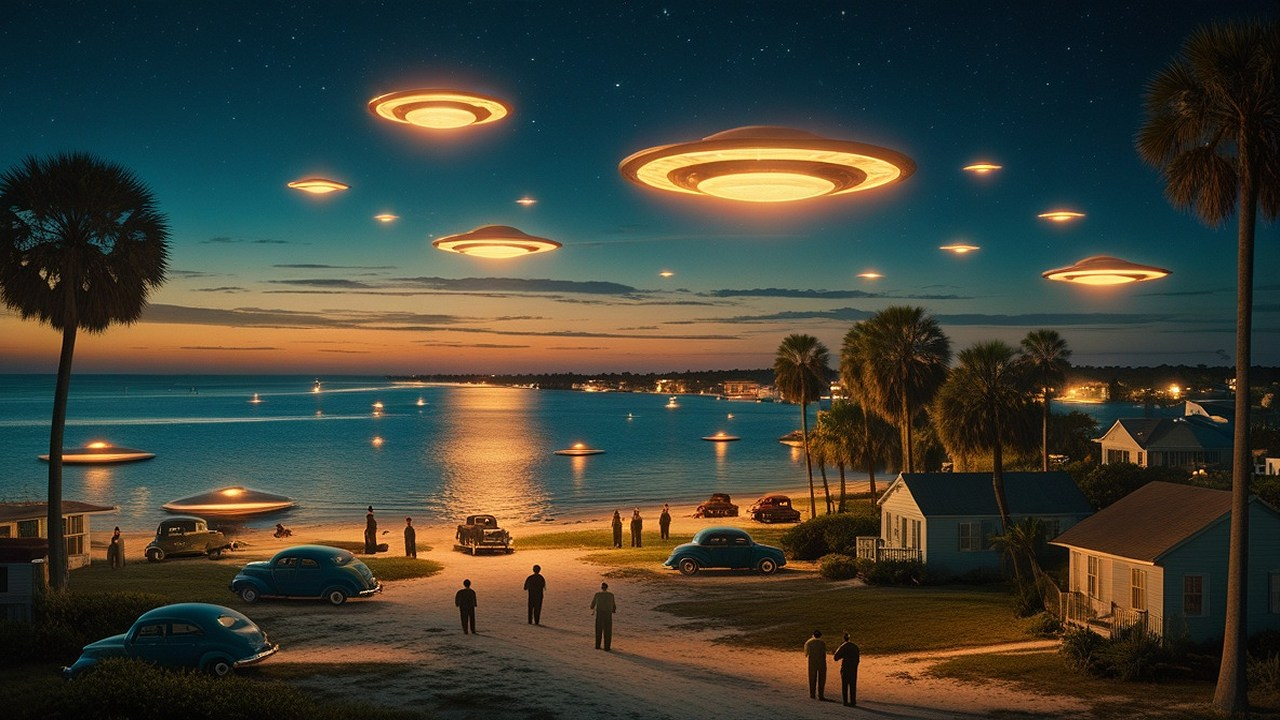
While many remember the famous cases from the Pacific Northwest and the Southwest, Florida was very much part of this historic wave. From late June through July 1947, residents across the Sunshine State reported strange disc-shaped objects, bright metallic shapes, and high-speed aerial phenomena that did not match any known aircraft. These Florida sightings, though often brief in the newspapers of the time, represent one of the earliest concentrated clusters of UFO reports in the state’s history.
This is the story of the 1947 Flying Disc Wave as it swept across Florida.
Let’s travel back to that pivotal summer.
World War II had ended just two years earlier. Florida had served as a major training ground for pilots and aircrews. Airfields, radar stations, and experimental aviation facilities were still active across the state. Citizens were more familiar with aircraft than ever before. Yet when strange objects began appearing in the skies over Tampa, Miami, St. Petersburg, Gainesville, Fort Myers, and other communities, they didn’t look or behave like anything people recognized.
Local newspapers in Tampa and Miami carried short accounts of the sightings alongside national stories. Witnesses included fishermen, homeowners, drivers, small commercial pilots, and individuals with technical or military backgrounds. The descriptions followed the national pattern: discs, circular objects, or bright metallic shapes moving at high speeds, sometimes darting at sharp angles or traveling in formations. Some glinted in the sunlight. Others moved silently. Many reports emphasized maneuverability that seemed impossible for the aircraft of the era.
The timing was crucial. The national wave created a ready-made frame of reference. Before Kenneth Arnold’s sighting, an unusual light in the sky might have been dismissed as a star, a balloon, or a plane. After the wave began, people had new language — “flying disc” — and a new cultural lens through which to interpret what they saw. Florida residents who witnessed something strange felt empowered to report it to local papers. This marked an important cultural shift: reporting aerial anomalies became more acceptable.
Florida’s geography played a significant role. With its wide-open skies, long coastlines, and frequent outdoor lifestyle, residents spent considerable time looking upward. Clear summer evenings over the Gulf and Atlantic coasts provided excellent conditions for spotting bright objects or high-altitude phenomena. Fishermen working at night, homeowners in coastal neighborhoods, and drivers on open roads all contributed reports. The state’s many airfields and military installations meant people were accustomed to seeing aircraft, which made the new objects stand out even more clearly.
While none of the Florida sightings in 1947 produced a major crash or large-scale military investigation, they contributed meaningfully to the national conversation. Newspapers often ran Florida accounts alongside reports from other states, showing how the phenomenon was nationwide. This created a sense of shared experience — ordinary Americans from coast to coast were seeing something unprecedented.
The public reaction in Florida reflected the uncertainties of the time. The Cold War was just beginning to take shape. Some speculated the discs were secret American experimental aircraft. Others wondered about foreign technology. A smaller but growing number began considering the possibility of something entirely unknown. Editorials and letters to the editor debated these ideas. The sightings did not produce definitive answers, but they helped fuel public curiosity and skepticism toward quick official explanations.
One of the most lasting impacts of the 1947 wave in Florida was the normalization of reporting. Before that summer, unusual aerial sightings were often kept private for fear of ridicule. After 1947, more people felt comfortable coming forward. This cultural change helped lay the groundwork for later decades of reporting in the state. When new waves occurred in Florida during the 1950s and beyond, the memory of 1947 provided context. The public already understood that strange things could appear in the skies over the Sunshine State.
The 1947 sightings also reflected broader societal shifts. Aviation had transformed American life. The idea of humans reaching beyond Earth was beginning to enter popular imagination. Against this backdrop, the flying disc wave raised profound questions about technology, exploration, and humanity’s place in the universe. Florida residents, like people across the country, looked up that summer and wondered.
Although individual Florida reports were often short — a few lines in local papers — their collective weight mattered. They showed that the phenomenon was not limited to remote Western deserts or major military zones. It appeared over cities, small towns, coastal waters, and rural areas alike. This nationwide distribution strengthened the idea that something genuinely new and unexplained was occurring.
The Florida cluster during June and July 1947 stands as an important early chapter in the state’s UFO history. The sightings helped establish a precedent: Florida was not isolated from national aerial mysteries. Instead, it was an active participant. This early involvement helped shape how later generations of Floridians would interpret unusual events in their skies.
Today, as we examine historical cases with fresh eyes and better tools, the 1947 Florida sightings deserve renewed attention. They remind us that the modern UFO phenomenon did not begin in a vacuum. It began with ordinary people — fishermen, pilots, homeowners, and drivers — who looked up during the summer of 1947 and saw something that did not fit their understanding of the world.
The flying discs that moved across Florida skies that summer may never be fully explained. But their appearance helped change how Americans viewed the sky itself. What was once seen as empty space or familiar aviation routes became a realm of possibility — a place where the unknown could appear at any moment.
More than seventy-five years later, the 1947 wave continues to matter. It shows us that the mystery has deep roots. It demonstrates how quickly public awareness can shift when a new phenomenon captures the national imagination. And it reminds us that ordinary citizens, in everyday places like Tampa, Miami, and Gainesville, became the first witnesses to a mystery that remains with us today.
The summer of 1947 was not just a passing news story. It was the beginning of a conversation that continues in our time — a conversation about what shares our skies and what it might mean for all of us.
As we push for greater transparency and scientific study of UAP in the 21st century, the Florida sightings of 1947 provide essential historical context. They show that this is not a new story. It is a long, ongoing story — one that has touched every part of America, including the Sunshine State.
The people of Florida who looked upward in the summer of 1947 saw something unexplained. Their reports, however brief, helped write the first chapter of Florida’s modern UFO history — a chapter that deserves to be remembered as part of the larger American experience with the unknown.
In the summer of 1947, America changed forever. On June 24, private pilot Kenneth Arnold reported seeing nine gleaming objects skipping across the sky near Mount Rainier, Washington. The press called them “flying saucers,” and within days, the term exploded into the national consciousness. Hundreds of sightings poured in from nearly every state. The modern UFO phenomenon had begun.
While many remember the famous cases from the Pacific Northwest and the Southwest, Florida was very much part of this historic wave. From late June through July 1947, residents across the Sunshine State reported strange disc-shaped objects, bright metallic shapes, and high-speed aerial phenomena that did not match any known aircraft. These Florida sightings, though often brief in the newspapers of the time, represent one of the earliest concentrated clusters of UFO reports in the state’s history.
This is the story of the 1947 Flying Disc Wave as it swept across Florida.
Let’s travel back to that pivotal summer.
World War II had ended just two years earlier. Florida had served as a major training ground for pilots and aircrews. Airfields, radar stations, and experimental aviation facilities were still active across the state. Citizens were more familiar with aircraft than ever before. Yet when strange objects began appearing in the skies over Tampa, Miami, St. Petersburg, Gainesville, Fort Myers, and other communities, they didn’t look or behave like anything people recognized.
Local newspapers in Tampa and Miami carried short accounts of the sightings alongside national stories. Witnesses included fishermen, homeowners, drivers, small commercial pilots, and individuals with technical or military backgrounds. The descriptions followed the national pattern: discs, circular objects, or bright metallic shapes moving at high speeds, sometimes darting at sharp angles or traveling in formations. Some glinted in the sunlight. Others moved silently. Many reports emphasized maneuverability that seemed impossible for the aircraft of the era.
The timing was crucial. The national wave created a ready-made frame of reference. Before Kenneth Arnold’s sighting, an unusual light in the sky might have been dismissed as a star, a balloon, or a plane. After the wave began, people had new language — “flying disc” — and a new cultural lens through which to interpret what they saw. Florida residents who witnessed something strange felt empowered to report it to local papers. This marked an important cultural shift: reporting aerial anomalies became more acceptable.
Florida’s geography played a significant role. With its wide-open skies, long coastlines, and frequent outdoor lifestyle, residents spent considerable time looking upward. Clear summer evenings over the Gulf and Atlantic coasts provided excellent conditions for spotting bright objects or high-altitude phenomena. Fishermen working at night, homeowners in coastal neighborhoods, and drivers on open roads all contributed reports. The state’s many airfields and military installations meant people were accustomed to seeing aircraft, which made the new objects stand out even more clearly.
While none of the Florida sightings in 1947 produced a major crash or large-scale military investigation, they contributed meaningfully to the national conversation. Newspapers often ran Florida accounts alongside reports from other states, showing how the phenomenon was nationwide. This created a sense of shared experience — ordinary Americans from coast to coast were seeing something unprecedented.
The public reaction in Florida reflected the uncertainties of the time. The Cold War was just beginning to take shape. Some speculated the discs were secret American experimental aircraft. Others wondered about foreign technology. A smaller but growing number began considering the possibility of something entirely unknown. Editorials and letters to the editor debated these ideas. The sightings did not produce definitive answers, but they helped fuel public curiosity and skepticism toward quick official explanations.
One of the most lasting impacts of the 1947 wave in Florida was the normalization of reporting. Before that summer, unusual aerial sightings were often kept private for fear of ridicule. After 1947, more people felt comfortable coming forward. This cultural change helped lay the groundwork for later decades of reporting in the state. When new waves occurred in Florida during the 1950s and beyond, the memory of 1947 provided context. The public already understood that strange things could appear in the skies over the Sunshine State.
The 1947 sightings also reflected broader societal shifts. Aviation had transformed American life. The idea of humans reaching beyond Earth was beginning to enter popular imagination. Against this backdrop, the flying disc wave raised profound questions about technology, exploration, and humanity’s place in the universe. Florida residents, like people across the country, looked up that summer and wondered.
Although individual Florida reports were often short — a few lines in local papers — their collective weight mattered. They showed that the phenomenon was not limited to remote Western deserts or major military zones. It appeared over cities, small towns, coastal waters, and rural areas alike. This nationwide distribution strengthened the idea that something genuinely new and unexplained was occurring.
The Florida cluster during June and July 1947 stands as an important early chapter in the state’s UFO history. The sightings helped establish a precedent: Florida was not isolated from national aerial mysteries. Instead, it was an active participant. This early involvement helped shape how later generations of Floridians would interpret unusual events in their skies.
Today, as we examine historical cases with fresh eyes and better tools, the 1947 Florida sightings deserve renewed attention. They remind us that the modern UFO phenomenon did not begin in a vacuum. It began with ordinary people — fishermen, pilots, homeowners, and drivers — who looked up during the summer of 1947 and saw something that did not fit their understanding of the world.
The flying discs that moved across Florida skies that summer may never be fully explained. But their appearance helped change how Americans viewed the sky itself. What was once seen as empty space or familiar aviation routes became a realm of possibility — a place where the unknown could appear at any moment.
More than seventy-five years later, the 1947 wave continues to matter. It shows us that the mystery has deep roots. It demonstrates how quickly public awareness can shift when a new phenomenon captures the national imagination. And it reminds us that ordinary citizens, in everyday places like Tampa, Miami, and Gainesville, became the first witnesses to a mystery that remains with us today.
The summer of 1947 was not just a passing news story. It was the beginning of a conversation that continues in our time — a conversation about what shares our skies and what it might mean for all of us.
As we push for greater transparency and scientific study of UAP in the 21st century, the Florida sightings of 1947 provide essential historical context. They show that this is not a new story. It is a long, ongoing story — one that has touched every part of America, including the Sunshine State.
The people of Florida who looked upward in the summer of 1947 saw something unexplained. Their reports, however brief, helped write the first chapter of Florida’s modern UFO history — a chapter that deserves to be remembered as part of the larger American experience with the unknown.