


Blog Categories
- African Incidents
- Atlantis Incidents
- Australian Incidents
- Belgian Incidents
- Bermuda Triangle Incidents
- Brazilian Incidents
- Canadian Incidents
- Chinese Incidents
- European Incidents
- France Incidents
- Ghosts
- Giants
- Italy Incidents
- Japanese Incidents
- Middle East Incidents
- Portugal Incidents
- Project Serpo
- Puerto Rico Incidents
- Russian Incidents
- Sasquatch
- Scandinavia Incidents
- Spanish Incidents
- UFOs
- United Kingdom Incidents
- United States Incidents
The Clearwater UFO Incident of July 1947
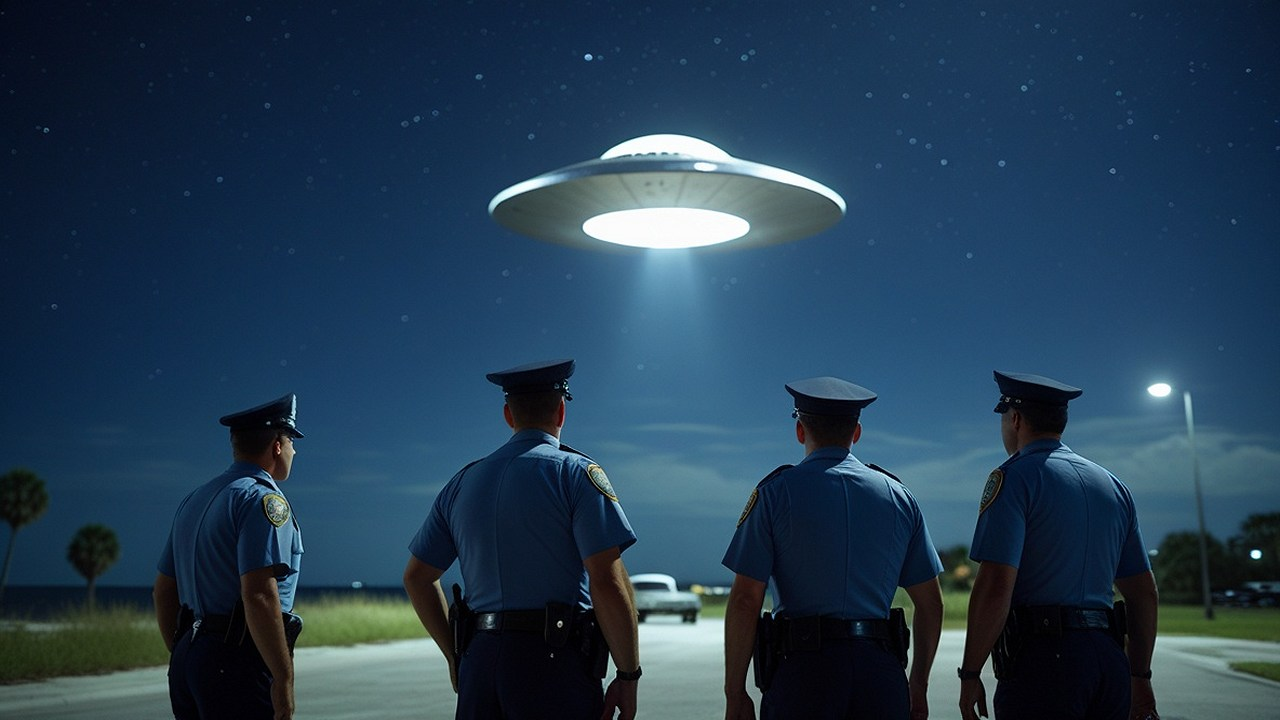
In the summer of 1947, the United States was gripped by one of the most extraordinary waves of public fascination in its history. Reports of “flying discs” flooded newspapers, radio broadcasts, and everyday conversations from coast to coast. It all began shortly after a widely publicized sighting in Washington State and quickly spread nationwide. Against this charged backdrop, on the night of July 15, 1947, the city of Clearwater, Florida, recorded an incident that stands out in the archival record of the flying-disc era. According to the Project 1947 compilation and surviving newspaper indexing, Clearwater police responded to a call and discovered an object in a vacant lot: a kite or similar frame to which a silver-painted disk shape had been attached. The report, as noted in the Clearwater Sun of July 17, 1947, page 14, documented this physical object at a time when most other sightings lacked physical trace or confirmation.
This is the story of the Clearwater kite incident — a grounded, tangible case from the height of the 1947 flying disc wave that reveals how deeply the national mystery penetrated everyday American life. While many reports from that summer involved distant lights or fast-moving shapes in the sky, this one left something behind for police to examine. Welcome to the channel. Today we examine this well-documented Florida case from the legendary summer of 1947 and what it tells us about the cultural power of the flying disc phenomenon.
The summer of 1947 marked the beginning of the modern UFO era. A pilot’s sighting near Mount Rainier on June 24 triggered a cascade of reports that spread rapidly through newspapers and radio. Florida newspapers, like those across the country, were printing short articles about sightings from multiple regions. Residents of Clearwater would have been aware of reports in Tampa, St. Petersburg, Miami, and elsewhere through both statewide and national press networks. The discussions were in the air — literally and socially. With the nation talking about mysterious disc-shaped craft possibly crossing American skies, the idea of a “silver disc” had become instantly recognizable, even iconic, within a matter of weeks.
On July 15, Clearwater police responded to a citizen report and found the object in a vacant lot. It was a kite or similar frame with a silver-painted disk attached. The discovery was documented in the local newspaper just two days later. This physical evidence made the Clearwater case distinctive. While thousands of other 1947 reports remained visual only — lights in the sky, shapes at altitude, or objects moving across the horizon — here was something concrete that authorities could examine on the ground.
The simplicity of the object stands in sharp contrast to the more dramatic or speculative accounts circulating at the time. A kite with a painted silver disc could have been created for many reasons. Some individuals may have launched homemade devices to see whether they could replicate sightings or simply to stir curiosity. Others may have been conducting personal experiments in aerodynamics, inspired by the postwar wave of aviation interest. In some cases, the construction of such a device could have been a prank or a playful commentary on the national conversation.
Regardless of the motive, the incident highlights an important aspect of how the 1947 sightings were understood. For many Americans, the idea of flying discs was not immediately associated with extraterrestrial or otherworldly origins. Instead, it was linked to the possibility of new aviation technology, whether military or civilian. It was an era shaped by rapid technological advances following World War II, and many assumed that new aircraft prototypes might already exist but remain undisclosed. Therefore, when an object resembling the popularized disc imagery appeared in a vacant lot, it may not have seemed absurd or implausible — it may have appeared almost expected.
The Clearwater police response itself demonstrates how seriously even small-town authorities were inclined to treat such reports during the height of the nationwide wave. The flying-disc phenomenon was widespread enough that officials could not simply ignore reports, even if the object turned out to be ordinary or homemade. Filing a report, examining the object, and entering the event into routine police record-keeping reflected the broader societal need to acknowledge and track what was being seen or found. Even an object as modest as a kite with a painted disc became a piece of evidence in the story of how the phenomenon influenced everyday life.
The impact of the Clearwater kite incident can be considered in several ways. First, it illustrates how cultural moments can shape behavior. The disc craze was not fueled solely by sightings; it was amplified by newspaper repetition, public speculation, and a growing sense that something unknown was happening. Ideas about the sky became part of communal conversation, and that conversation created new actions, whether serious, experimental, or playful.
Second, the incident serves as a reminder that the flying-disc wave was as much a social phenomenon as an observational one. Reports were shaped not only by what people saw, but by what they believed, feared, wondered, or, in some cases, wished to express. The Clearwater object did not appear in the air; it appeared on the ground, suggesting that the imagery of the disc had already become a symbol — something that could be imitated, referenced, or interacted with physically.
Third, this event contributes to the ongoing historical record of how early flying-disc reports were handled and remembered. Because this case includes a newspaper reference with a specific date and page, it stands as one of the more firmly documented Florida entries from the wave. That clarity allows historians and researchers to place the incident within the broader timeline of the summer of 1947, confirming that Florida’s involvement in the wave included not only sightings but physical engagements with disc imagery.
The legacy of the Clearwater kite incident remains subtle yet telling. It did not become a famous case or a subject of investigation by government agencies. It did not involve dramatic claims, high-profile witnesses, or extended public debate. Its significance lies in its ordinariness. It shows how deeply the flying-disc idea entered daily life — so much so that someone, somewhere in Clearwater, felt moved to create a disc-like object and place or fly it in an environment where it may have been seen and reported.
The incident also offers a useful lesson for researchers: not all sightings or reports from the wave were extraordinary or mysterious. Some were pranks. Some were attempts to replicate what others saw. Some were misunderstandings or misinterpretations. Yet they all form part of the same historical moment — a moment when the sight of something unfamiliar in the sky, or even the suggestion of it, had become meaningful.
The 1947 Clearwater kite remains a small but important piece of Florida’s place in the flying-disc era. It demonstrates how national narratives shape local action, how imagery spreads across culture, and how moments of curiosity and uncertainty can manifest in unexpected forms. While many sightings from the summer of 1947 remain unexplained or debated, the Clearwater incident stands apart in its clarity: an object was found, described, and recorded. Its meaning may rest not in what it was, but in what it reflected — the imagination of a nation looking upward, wondering what the future held, and trying to give shape to the unknown.
Even in cases like Clearwater, where the object turned out to be a simple kite with a painted disc, the broader context of the 1947 wave remains powerful. The sheer volume of reports that summer — many of them visual sightings without physical evidence — created an atmosphere in which even a homemade device could capture attention and enter the official record. The Clearwater incident reminds us that the flying disc phenomenon was not only about what was in the sky; it was also about how society responded to the possibility of the unknown.
As we continue to study the history of unidentified aerial phenomena, cases like the Clearwater kite provide valuable insight into the cultural and social dimensions of the mystery. They show that the 1947 wave was a nationwide event that touched ordinary communities in ordinary ways — sometimes through sightings, sometimes through objects left behind, and always through the shared sense that something extraordinary might be happening overhead.
The skies over Florida in July 1947 were alive with possibility. Whether the objects people saw were advanced aircraft, misidentifications, or something else entirely, the Clearwater kite stands as a tangible reminder of how deeply that summer’s mystery entered the American imagination. An object was found in a vacant lot, reported to police, and recorded in the local newspaper. Its story endures not because it was mysterious in itself, but because it captured the spirit of an entire nation looking up and wondering.
In the summer of 1947, the United States was gripped by one of the most extraordinary waves of public fascination in its history. Reports of “flying discs” flooded newspapers, radio broadcasts, and everyday conversations from coast to coast. It all began shortly after a widely publicized sighting in Washington State and quickly spread nationwide. Against this charged backdrop, on the night of July 15, 1947, the city of Clearwater, Florida, recorded an incident that stands out in the archival record of the flying-disc era. According to the Project 1947 compilation and surviving newspaper indexing, Clearwater police responded to a call and discovered an object in a vacant lot: a kite or similar frame to which a silver-painted disk shape had been attached. The report, as noted in the Clearwater Sun of July 17, 1947, page 14, documented this physical object at a time when most other sightings lacked physical trace or confirmation.
This is the story of the Clearwater kite incident — a grounded, tangible case from the height of the 1947 flying disc wave that reveals how deeply the national mystery penetrated everyday American life. While many reports from that summer involved distant lights or fast-moving shapes in the sky, this one left something behind for police to examine. Welcome to the channel. Today we examine this well-documented Florida case from the legendary summer of 1947 and what it tells us about the cultural power of the flying disc phenomenon.
The summer of 1947 marked the beginning of the modern UFO era. A pilot’s sighting near Mount Rainier on June 24 triggered a cascade of reports that spread rapidly through newspapers and radio. Florida newspapers, like those across the country, were printing short articles about sightings from multiple regions. Residents of Clearwater would have been aware of reports in Tampa, St. Petersburg, Miami, and elsewhere through both statewide and national press networks. The discussions were in the air — literally and socially. With the nation talking about mysterious disc-shaped craft possibly crossing American skies, the idea of a “silver disc” had become instantly recognizable, even iconic, within a matter of weeks.
On July 15, Clearwater police responded to a citizen report and found the object in a vacant lot. It was a kite or similar frame with a silver-painted disk attached. The discovery was documented in the local newspaper just two days later. This physical evidence made the Clearwater case distinctive. While thousands of other 1947 reports remained visual only — lights in the sky, shapes at altitude, or objects moving across the horizon — here was something concrete that authorities could examine on the ground.
The simplicity of the object stands in sharp contrast to the more dramatic or speculative accounts circulating at the time. A kite with a painted silver disc could have been created for many reasons. Some individuals may have launched homemade devices to see whether they could replicate sightings or simply to stir curiosity. Others may have been conducting personal experiments in aerodynamics, inspired by the postwar wave of aviation interest. In some cases, the construction of such a device could have been a prank or a playful commentary on the national conversation.
Regardless of the motive, the incident highlights an important aspect of how the 1947 sightings were understood. For many Americans, the idea of flying discs was not immediately associated with extraterrestrial or otherworldly origins. Instead, it was linked to the possibility of new aviation technology, whether military or civilian. It was an era shaped by rapid technological advances following World War II, and many assumed that new aircraft prototypes might already exist but remain undisclosed. Therefore, when an object resembling the popularized disc imagery appeared in a vacant lot, it may not have seemed absurd or implausible — it may have appeared almost expected.
The Clearwater police response itself demonstrates how seriously even small-town authorities were inclined to treat such reports during the height of the nationwide wave. The flying-disc phenomenon was widespread enough that officials could not simply ignore reports, even if the object turned out to be ordinary or homemade. Filing a report, examining the object, and entering the event into routine police record-keeping reflected the broader societal need to acknowledge and track what was being seen or found. Even an object as modest as a kite with a painted disc became a piece of evidence in the story of how the phenomenon influenced everyday life.
The impact of the Clearwater kite incident can be considered in several ways. First, it illustrates how cultural moments can shape behavior. The disc craze was not fueled solely by sightings; it was amplified by newspaper repetition, public speculation, and a growing sense that something unknown was happening. Ideas about the sky became part of communal conversation, and that conversation created new actions, whether serious, experimental, or playful.
Second, the incident serves as a reminder that the flying-disc wave was as much a social phenomenon as an observational one. Reports were shaped not only by what people saw, but by what they believed, feared, wondered, or, in some cases, wished to express. The Clearwater object did not appear in the air; it appeared on the ground, suggesting that the imagery of the disc had already become a symbol — something that could be imitated, referenced, or interacted with physically.
Third, this event contributes to the ongoing historical record of how early flying-disc reports were handled and remembered. Because this case includes a newspaper reference with a specific date and page, it stands as one of the more firmly documented Florida entries from the wave. That clarity allows historians and researchers to place the incident within the broader timeline of the summer of 1947, confirming that Florida’s involvement in the wave included not only sightings but physical engagements with disc imagery.
The legacy of the Clearwater kite incident remains subtle yet telling. It did not become a famous case or a subject of investigation by government agencies. It did not involve dramatic claims, high-profile witnesses, or extended public debate. Its significance lies in its ordinariness. It shows how deeply the flying-disc idea entered daily life — so much so that someone, somewhere in Clearwater, felt moved to create a disc-like object and place or fly it in an environment where it may have been seen and reported.
The incident also offers a useful lesson for researchers: not all sightings or reports from the wave were extraordinary or mysterious. Some were pranks. Some were attempts to replicate what others saw. Some were misunderstandings or misinterpretations. Yet they all form part of the same historical moment — a moment when the sight of something unfamiliar in the sky, or even the suggestion of it, had become meaningful.
The 1947 Clearwater kite remains a small but important piece of Florida’s place in the flying-disc era. It demonstrates how national narratives shape local action, how imagery spreads across culture, and how moments of curiosity and uncertainty can manifest in unexpected forms. While many sightings from the summer of 1947 remain unexplained or debated, the Clearwater incident stands apart in its clarity: an object was found, described, and recorded. Its meaning may rest not in what it was, but in what it reflected — the imagination of a nation looking upward, wondering what the future held, and trying to give shape to the unknown.
Even in cases like Clearwater, where the object turned out to be a simple kite with a painted disc, the broader context of the 1947 wave remains powerful. The sheer volume of reports that summer — many of them visual sightings without physical evidence — created an atmosphere in which even a homemade device could capture attention and enter the official record. The Clearwater incident reminds us that the flying disc phenomenon was not only about what was in the sky; it was also about how society responded to the possibility of the unknown.
As we continue to study the history of unidentified aerial phenomena, cases like the Clearwater kite provide valuable insight into the cultural and social dimensions of the mystery. They show that the 1947 wave was a nationwide event that touched ordinary communities in ordinary ways — sometimes through sightings, sometimes through objects left behind, and always through the shared sense that something extraordinary might be happening overhead.
The skies over Florida in July 1947 were alive with possibility. Whether the objects people saw were advanced aircraft, misidentifications, or something else entirely, the Clearwater kite stands as a tangible reminder of how deeply that summer’s mystery entered the American imagination. An object was found in a vacant lot, reported to police, and recorded in the local newspaper. Its story endures not because it was mysterious in itself, but because it captured the spirit of an entire nation looking up and wondering.