


Blog Categories
- African Incidents
- Atlantis Incidents
- Australian Incidents
- Belgian Incidents
- Bermuda Triangle Incidents
- Brazilian Incidents
- Canadian Incidents
- Chinese Incidents
- European Incidents
- France Incidents
- Ghosts
- Giants
- Italy Incidents
- Japanese Incidents
- Middle East Incidents
- Portugal Incidents
- Project Serpo
- Puerto Rico Incidents
- Russian Incidents
- Sasquatch
- Scandinavia Incidents
- Spanish Incidents
- UFOs
- United Kingdom Incidents
- United States Incidents
The Dawn of Disclosure 1950: Major Donald E. Keyhoe
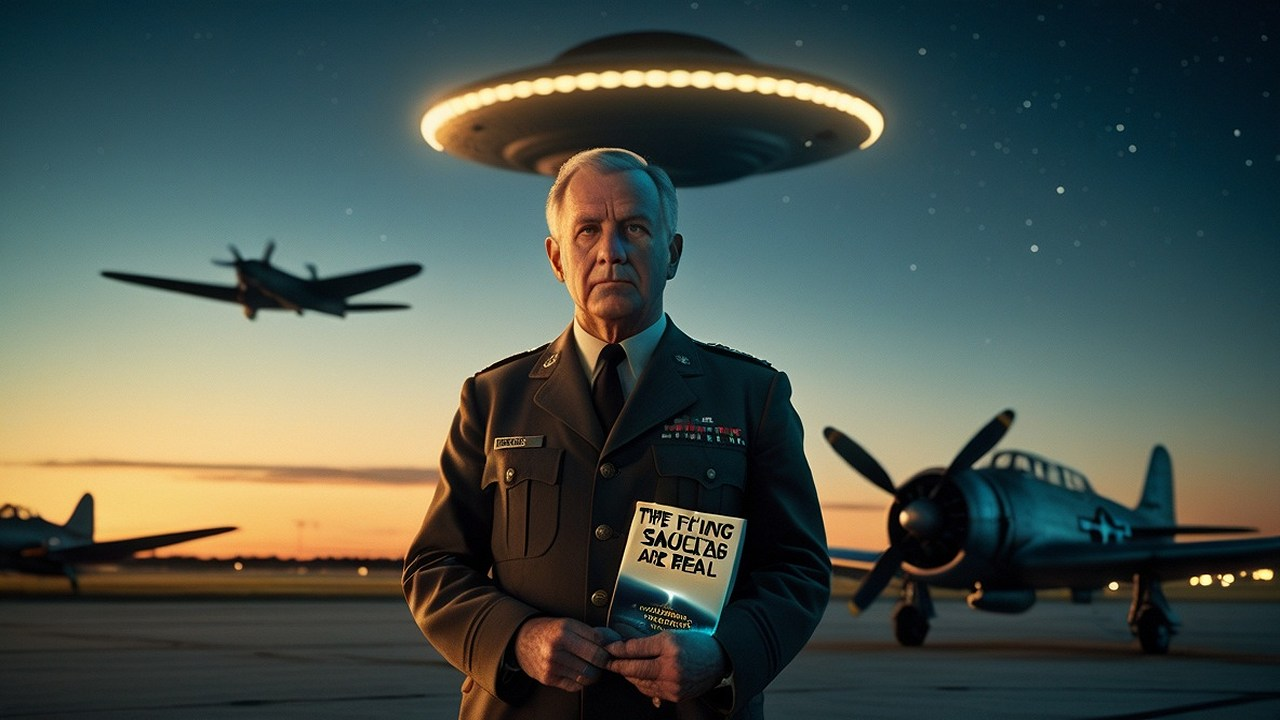
In 1950, just three years after pilot Kenneth Arnold sparked a worldwide UFO wave by describing nine gleaming discs skipping across the sky near Mount Rainier, one man stepped forward with a message that would shake the foundations of official secrecy. That man was Major Donald E. Keyhoe — a decorated U.S. Marine Corps aviator, aviation expert, and respected journalist. His groundbreaking book, The Flying Saucers Are Real, didn’t just claim that UFOs were real. It declared they were intelligently controlled vehicles from beyond Earth — and that the U.S. Air Force was actively hiding the truth from the American public.
This is the story of the book that launched the modern fight for UFO disclosure. A book that sold over half a million copies, ignited public debate, and established the blueprint for every whistleblower and researcher who followed. Welcome to one of the most important chapters in UFO history.
Donald Edward Keyhoe was born in 1897. He graduated from the U.S. Naval Academy in 1919 and served as a naval aviator in the Marine Corps during World War I. After a serious plane crash in Guam in 1922 left him with a permanent arm injury, he resigned from active duty but retained his commission, eventually retiring as a Major. In civilian life, Keyhoe became deeply embedded in the world of aviation. He managed promotional tours for pioneers like Charles Lindbergh and chronicled the experience in his 1928 book Flying with Lindbergh. He wrote extensively for major magazines including The Saturday Evening Post and Reader’s Digest, earning a reputation for integrity and expertise.
By the late 1940s, Keyhoe’s extensive military and aviation contacts placed him in a unique position. When True magazine editor Ken Purdy assigned him to investigate the flood of flying saucer reports in 1949, Keyhoe approached the subject as a skeptic. What he discovered changed everything.
His December 1949 article in True magazine, titled “The Flying Saucers Are Real,” became one of the most widely read and discussed articles in publishing history. Edward J. Ruppelt, who later headed Project Blue Book, acknowledged its massive impact. Keyhoe expanded the article into his landmark 1950 paperback The Flying Saucers Are Real — a compact 175-page book that sold for just 25 cents and quickly became a cultural phenomenon.
In the book, Keyhoe meticulously compiled evidence from military pilots, radar operators, and other credible witnesses between 1947 and 1949. He argued that these craft were not illusions, weather balloons, or secret American technology. They were intelligently controlled vehicles from another world, likely monitoring Earth’s atomic activities following the 1945 nuclear detonations.
Keyhoe traced the phenomenon back centuries, noting reports of spindle-shaped objects and luminous bodies as early as 1762. He highlighted the dramatic increase in sightings after humanity split the atom, suggesting that advanced civilizations were taking notice of our technological leap — and our potential for self-destruction.
Among the cornerstone cases Keyhoe examined was the 1947 Kenneth Arnold sighting itself — nine shiny discs flying in formation at estimated speeds of 1,200 miles per hour, making impossible maneuvers around mountain peaks. He detailed the United Airlines crew encounter over Idaho, where five large discs paced their aircraft before vanishing. Perhaps most dramatically, he covered the tragic Mantell incident of January 1948. Air Force pilot Captain Thomas Mantell pursued a massive metallic object estimated to be up to 1,000 feet in diameter. He climbed too high in his P-51 Mustang, and the plane disintegrated. The Air Force’s public explanation — that Mantell was chasing Venus — was contradicted by internal reports and multiple ground witnesses.
Keyhoe also examined the Chiles-Whitted encounter, where Eastern Airlines pilots observed a 100-foot cigar-shaped craft with windows and a blue glow, accelerating away at incredible speed. He brought in international cases, including ghost rockets over Europe and an oval object seen during Nicholas Roerich’s 1934 expedition in Tibet. Through these accounts, Keyhoe built a powerful case: these were not random anomalies but systematic visits by superior intelligences using propulsion systems far beyond human capability.
At the heart of The Flying Saucers Are Real was Keyhoe’s explosive accusation: the U.S. Air Force was engaged in a deliberate campaign of denial and suppression. He revealed how Project Sign — later renamed Project Grudge and then Project Blue Book — had initially taken the phenomenon seriously before shifting to public dismissal. Keyhoe exposed inconsistencies, such as the Mantell case being listed as “unidentified” internally while explained away publicly as Venus. He claimed the military had obtained fragments of these craft and was attempting to reverse-engineer them, all while threatening witnesses with court-martial if they spoke out.
This was explosive stuff in 1950. Keyhoe wasn’t a fringe figure. He was a respected former Marine aviator with deep Pentagon connections. His whistleblower stance carried real weight.
The book’s impact was immediate and profound. It sold over half a million copies and sparked nationwide debate. In an era of Cold War fears and rapid technological change, Keyhoe gave the public a coherent framework for understanding the saucer mystery. He distinguished serious research from tabloid sensationalism, focusing on military-grade evidence. The book inspired countless readers to come forward with their own sightings and helped fuel the creation of civilian UFO research organizations.
Keyhoe didn’t stop there. In 1956 he helped found the National Investigations Committee on Aerial Phenomena (NICAP), becoming its director in 1957. Under his leadership, NICAP grew to 15,000 members and became one of the most influential UFO organizations of its time. He continued writing books, including Flying Saucers from Outer Space (1953) and The Flying Saucer Conspiracy (1955), further exposing what he called the “silence group” within government enforcing secrecy.
His media appearances, including the infamous 1958 Armstrong Circle Theatre broadcast where he was cut off mid-sentence while discussing congressional evidence, only reinforced public suspicion of a cover-up.
Keyhoe’s influence extended far beyond his lifetime. He passed away in 1988, but his legacy lives on in every modern disclosure effort. When former intelligence official Luis Elizondo wrote Imminent in 2024, describing non-human craft and the need for transparency, he walked a path Keyhoe had paved decades earlier. When whistleblower David Grusch testified before Congress in 2023 about recovered non-human craft and biologics, he echoed claims Keyhoe had made in 1950.
Major Donald E. Keyhoe was the first major public figure to demand full disclosure. He insisted that the American people had a right to know the truth about these visitors. He warned that continued secrecy betrayed public trust and hindered humanity’s ability to prepare for contact with advanced civilizations.
More than seventy years later, we’re still fighting the same battle Keyhoe began. Official programs like AATIP and AARO, congressional hearings, and growing public pressure all trace their spiritual lineage back to that modest 25-cent paperback from 1950.
The Flying Saucers Are Real didn’t just document sightings. It ignited a movement. It proved that credible military insiders could challenge institutional secrecy and win public support. It showed that the extraterrestrial hypothesis was not fringe speculation but a rational conclusion based on the best available evidence.
In our current era of UAP disclosure, Keyhoe’s work feels more relevant than ever. The maneuvers he described in 1950 — right-angle turns at supersonic speeds, silent hovering, impossible acceleration — match the Navy’s own declassified videos released decades later. The pattern of suppression he exposed continues to this day.
Major Donald E. Keyhoe stood at the dawn of the modern UFO era and had the courage to speak truth to power. His book remains a cornerstone of the disclosure movement — a courageous testament to the reality of advanced intelligences visiting our world.
As we continue pushing for full transparency in the 21st century, we stand on the shoulders of pioneers like Keyhoe. The fight he started in 1950 is still unfolding. And the truth he demanded may finally be within reach.
What do you think? Was Donald Keyhoe right about the cover-up? Are we finally seeing the disclosure he fought for? Drop your thoughts in the comments.
If you enjoyed this deep dive into one of the most important figures in UFO history, make sure to like, subscribe, and hit the notification bell. We have many more groundbreaking cases and disclosure pioneers coming.
Thanks for watching. Keep looking up — and keep demanding the truth.
In 1950, just three years after pilot Kenneth Arnold sparked a worldwide UFO wave by describing nine gleaming discs skipping across the sky near Mount Rainier, one man stepped forward with a message that would shake the foundations of official secrecy. That man was Major Donald E. Keyhoe — a decorated U.S. Marine Corps aviator, aviation expert, and respected journalist. His groundbreaking book, The Flying Saucers Are Real, didn’t just claim that UFOs were real. It declared they were intelligently controlled vehicles from beyond Earth — and that the U.S. Air Force was actively hiding the truth from the American public.
This is the story of the book that launched the modern fight for UFO disclosure. A book that sold over half a million copies, ignited public debate, and established the blueprint for every whistleblower and researcher who followed. Welcome to one of the most important chapters in UFO history.
Donald Edward Keyhoe was born in 1897. He graduated from the U.S. Naval Academy in 1919 and served as a naval aviator in the Marine Corps during World War I. After a serious plane crash in Guam in 1922 left him with a permanent arm injury, he resigned from active duty but retained his commission, eventually retiring as a Major. In civilian life, Keyhoe became deeply embedded in the world of aviation. He managed promotional tours for pioneers like Charles Lindbergh and chronicled the experience in his 1928 book Flying with Lindbergh. He wrote extensively for major magazines including The Saturday Evening Post and Reader’s Digest, earning a reputation for integrity and expertise.
By the late 1940s, Keyhoe’s extensive military and aviation contacts placed him in a unique position. When True magazine editor Ken Purdy assigned him to investigate the flood of flying saucer reports in 1949, Keyhoe approached the subject as a skeptic. What he discovered changed everything.
His December 1949 article in True magazine, titled “The Flying Saucers Are Real,” became one of the most widely read and discussed articles in publishing history. Edward J. Ruppelt, who later headed Project Blue Book, acknowledged its massive impact. Keyhoe expanded the article into his landmark 1950 paperback The Flying Saucers Are Real — a compact 175-page book that sold for just 25 cents and quickly became a cultural phenomenon.
In the book, Keyhoe meticulously compiled evidence from military pilots, radar operators, and other credible witnesses between 1947 and 1949. He argued that these craft were not illusions, weather balloons, or secret American technology. They were intelligently controlled vehicles from another world, likely monitoring Earth’s atomic activities following the 1945 nuclear detonations.
Keyhoe traced the phenomenon back centuries, noting reports of spindle-shaped objects and luminous bodies as early as 1762. He highlighted the dramatic increase in sightings after humanity split the atom, suggesting that advanced civilizations were taking notice of our technological leap — and our potential for self-destruction.
Among the cornerstone cases Keyhoe examined was the 1947 Kenneth Arnold sighting itself — nine shiny discs flying in formation at estimated speeds of 1,200 miles per hour, making impossible maneuvers around mountain peaks. He detailed the United Airlines crew encounter over Idaho, where five large discs paced their aircraft before vanishing. Perhaps most dramatically, he covered the tragic Mantell incident of January 1948. Air Force pilot Captain Thomas Mantell pursued a massive metallic object estimated to be up to 1,000 feet in diameter. He climbed too high in his P-51 Mustang, and the plane disintegrated. The Air Force’s public explanation — that Mantell was chasing Venus — was contradicted by internal reports and multiple ground witnesses.
Keyhoe also examined the Chiles-Whitted encounter, where Eastern Airlines pilots observed a 100-foot cigar-shaped craft with windows and a blue glow, accelerating away at incredible speed. He brought in international cases, including ghost rockets over Europe and an oval object seen during Nicholas Roerich’s 1934 expedition in Tibet. Through these accounts, Keyhoe built a powerful case: these were not random anomalies but systematic visits by superior intelligences using propulsion systems far beyond human capability.
At the heart of The Flying Saucers Are Real was Keyhoe’s explosive accusation: the U.S. Air Force was engaged in a deliberate campaign of denial and suppression. He revealed how Project Sign — later renamed Project Grudge and then Project Blue Book — had initially taken the phenomenon seriously before shifting to public dismissal. Keyhoe exposed inconsistencies, such as the Mantell case being listed as “unidentified” internally while explained away publicly as Venus. He claimed the military had obtained fragments of these craft and was attempting to reverse-engineer them, all while threatening witnesses with court-martial if they spoke out.
This was explosive stuff in 1950. Keyhoe wasn’t a fringe figure. He was a respected former Marine aviator with deep Pentagon connections. His whistleblower stance carried real weight.
The book’s impact was immediate and profound. It sold over half a million copies and sparked nationwide debate. In an era of Cold War fears and rapid technological change, Keyhoe gave the public a coherent framework for understanding the saucer mystery. He distinguished serious research from tabloid sensationalism, focusing on military-grade evidence. The book inspired countless readers to come forward with their own sightings and helped fuel the creation of civilian UFO research organizations.
Keyhoe didn’t stop there. In 1956 he helped found the National Investigations Committee on Aerial Phenomena (NICAP), becoming its director in 1957. Under his leadership, NICAP grew to 15,000 members and became one of the most influential UFO organizations of its time. He continued writing books, including Flying Saucers from Outer Space (1953) and The Flying Saucer Conspiracy (1955), further exposing what he called the “silence group” within government enforcing secrecy.
His media appearances, including the infamous 1958 Armstrong Circle Theatre broadcast where he was cut off mid-sentence while discussing congressional evidence, only reinforced public suspicion of a cover-up.
Keyhoe’s influence extended far beyond his lifetime. He passed away in 1988, but his legacy lives on in every modern disclosure effort. When former intelligence official Luis Elizondo wrote Imminent in 2024, describing non-human craft and the need for transparency, he walked a path Keyhoe had paved decades earlier. When whistleblower David Grusch testified before Congress in 2023 about recovered non-human craft and biologics, he echoed claims Keyhoe had made in 1950.
Major Donald E. Keyhoe was the first major public figure to demand full disclosure. He insisted that the American people had a right to know the truth about these visitors. He warned that continued secrecy betrayed public trust and hindered humanity’s ability to prepare for contact with advanced civilizations.
More than seventy years later, we’re still fighting the same battle Keyhoe began. Official programs like AATIP and AARO, congressional hearings, and growing public pressure all trace their spiritual lineage back to that modest 25-cent paperback from 1950.
The Flying Saucers Are Real didn’t just document sightings. It ignited a movement. It proved that credible military insiders could challenge institutional secrecy and win public support. It showed that the extraterrestrial hypothesis was not fringe speculation but a rational conclusion based on the best available evidence.
In our current era of UAP disclosure, Keyhoe’s work feels more relevant than ever. The maneuvers he described in 1950 — right-angle turns at supersonic speeds, silent hovering, impossible acceleration — match the Navy’s own declassified videos released decades later. The pattern of suppression he exposed continues to this day.
Major Donald E. Keyhoe stood at the dawn of the modern UFO era and had the courage to speak truth to power. His book remains a cornerstone of the disclosure movement — a courageous testament to the reality of advanced intelligences visiting our world.
As we continue pushing for full transparency in the 21st century, we stand on the shoulders of pioneers like Keyhoe. The fight he started in 1950 is still unfolding. And the truth he demanded may finally be within reach.
What do you think? Was Donald Keyhoe right about the cover-up? Are we finally seeing the disclosure he fought for? Drop your thoughts in the comments.
If you enjoyed this deep dive into one of the most important figures in UFO history, make sure to like, subscribe, and hit the notification bell. We have many more groundbreaking cases and disclosure pioneers coming.
Thanks for watching. Keep looking up — and keep demanding the truth.