

Blog Categories
- African Incidents
- Atlantis Incidents
- Australian Incidents
- Belgian Incidents
- Bermuda Triangle Incidents
- Brazilian Incidents
- Canadian Incidents
- Chinese Incidents
- European Incidents
- France Incidents
- Ghosts
- Giants
- Italy Incidents
- Japanese Incidents
- Middle East Incidents
- Portugal Incidents
- Project Serpo
- Puerto Rico Incidents
- Russian Incidents
- Sasquatch
- Scandinavia Incidents
- Spanish Incidents
- UFOs
- United Kingdom Incidents
- United States Incidents
The Denver Airship Reports of April 1897
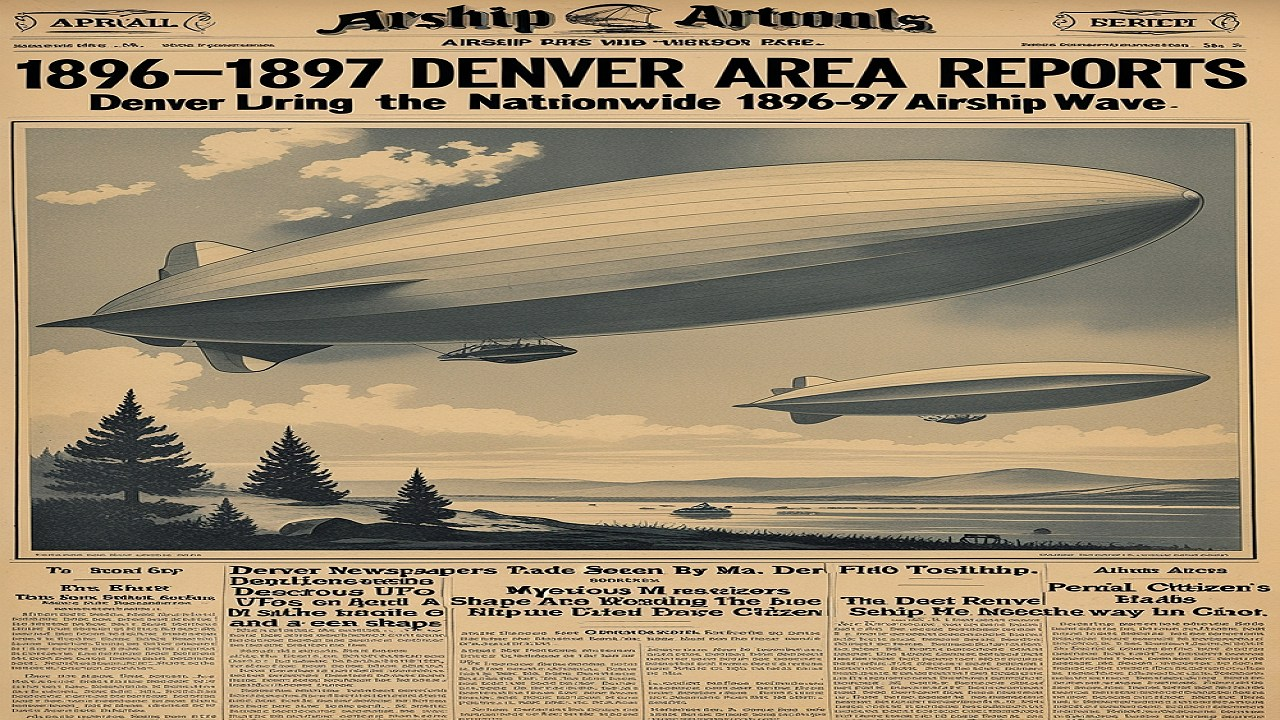
In the spring of 1897, an unusual phenomenon swept across the United States: reports of strange aerial vehicles variously called “air-ships,” “phantom airships,” or mysterious lights in the sky. This phenomenon, now often referred to as the Mystery Airship wave of 1896-97, involved eyewitness accounts of lights, shapes, and presumed flying craft, well before powered flight had become common. Among the many places reporting such phenomena, Denver, Colorado played a part. In mid-April 1897, Denver newspapers printed stories about citizens who said they saw a shape in the sky, mysterious lights, possibly flying machines. Those reports are part of the historical record of how people reacted to what they perceived to be something entirely new in the heavens.
What the Reports Said
The primary documented source for the Denver-area reports is The Rocky Mountain News, in its April 14, 1897 issue. One article in that paper refers to a theory advanced by “Professor Hough” (likely a scientist or astronomer consulted by the press) who speculated that some of the reports of air-ships might in fact be misidentifications of stars—among them a star named Alpha Ormois (or something similar in name). The article notes that many Denver citizens did not find this explanation satisfactory, that the supposed airship sightings had disturbed them, and that people were talking, wondering, describing what they saw.
The Denver reports share features common to many sightings around this time: nighttime sightings, bright lights, shapes or objects that seemed to move in ways inconsistent with simple stars or celestial objects. While the Denver accounts, as in many of these old newspaper reports, do not give elaborate technical descriptions (no consistent catalog of size, distance, structure, sound, etc.), the fact that multiple people in Denver reported seeing something was enough to make it news.
The reports also show that there was already public awareness of stories from other places (mines, frontier towns, etc.), so Denver citizens had context (or possibly preconceptions) for what they thought they might be seeing.
How It Affected People at the Time
Curiosity, Debate, and Skepticism: The Denver reports, like others in this wave, generated a mix of fascination and skepticism. The public seemed divided between those who believed they were witnessing real aerial inventions or unknown crafts, and those who thought misidentification (stars, planets, possibly meteors) or exaggeration was more likely. The mention of “Professor Hough’s theory” is an example of how scientific or educated circles attempted to offer rational explanations. But the fact that many citizens did not accept those explanations indicates that these sightings disturbed ordinary notions of the sky: people were unsure what was possible, and these phenomena tested the boundary between the familiar (stars, moonlight, atmospheric effects) and the unknown.
Media Sensation and Public Discourse: Newspapers like the Rocky Mountain News played a vital role in disseminating the stories, framing them, and in some cases sensationalizing parts of them. By reporting both the sightings and the skepticism, they facilitated public conversation about what technology might exist (or might exist secretly), about whether flying machines—air-ships—could be real, and what the future might bring. Many people were probably both excited and uneasy—excited because of the possibility of invention, progress, or even wonder; uneasy because of the unknown and because aviation was so new and its possibilities uncertain.
Human Imagination and Frontier Expectations: Denver in 1897 was not a remote frontier town, but it was part of the American West, with frontier mentality mixed with urbanizing progress. Mining, railroads, telegraph communication—all had introduced new technologies and new distances. At that time, the idea of flying machines was in the popular imagination (though heavier-than-air flight was still decades away from wide use). Thus when people saw lights or shapes in the sky that they could not explain, it tapped into both existing technological optimism and mystery.
The reports may have also raised anxieties—of invasion, of unknown power, of what lay beyond human understanding.
Notable People and Themes
Professor Hough: As mentioned, one of the figures cited in the April 14, 1897 report. Hough represents the educated skepticism of the era—the idea that some of these sightings were likely misidentifications of celestial bodies. His presence in the narrative shows that while the press was publishing stories of airships, it also was engaging with scientific reasoning and alternate hypotheses.
Denver Newspapers / Editors: The Rocky Mountain News, among others, played a crucial role, both recording local testimony and bringing in theories. Editors chose which stories to run, how to frame them, what skeptics to quote. That affects what information survived and how modern readers see them.
Ordinary Citizens / Witnesses: Although the names of many witnesses are not preserved in the articles I found, they are key: people who claimed to have seen something strange in the sky. Their testimonies, even when fragmentary, formed the substance of what was reported. Because many residents of Denver were familiar with the night skies (though perhaps less so with powered flight), their reports are more striking than if they came purely from remote or uneducated places, though perceptions can be fallible in all contexts.
Impact Then and Short-Term Consequences
Public Conversation and Fear/Excitement: The reports contributed to a sense of wonder and anxiety. People wondered what these “air-ships” might be, whether they were being built secretly, or whether they were supernatural or other-worldly. The unknown tends to fill with speculation. Even though there is no evidence the reports caused panic or mass hysteria in Denver in the archival material I found, they clearly stirred curiosity and discussion.
Speculation about Technology: Some people apparently speculated that inventors were working in secret on new flying machines; that perhaps these air-ships were demonstrations or tests. Others speculated they were purely natural phenomenon misperceived. The idea that powered aerial machines might become real was not far-fetched; lighter-than-air craft (balloons, dirigibles) were already known, though distance, control, and regularity of flight were very limited.
Scientific Engagement: People like “Professor Hough” represent early scientific engagement with these accounts. Scholars, astronomers, natural philosophers tried to explain visible lights in terms of stars, planets, reflections, atmospheric optics. This sets up a pattern that continues in later UFO history: eyewitnesses and the media report, scientists / skeptics propose alternate explanations, some believe, some doubt.
What Remains and the Legacy Today
Historical UFO / Airship Scholarship: The Denver reports are part of what historians, UFO researchers, and folklorists use when studying how early anomalies in the sky were perceived before modern aviation and aerospace frameworks. The 1896-97 wave is understood as a precursor to modern UFO reporting.
It helps trace how concepts of “craft,” “air-man,” “pilots,” and “alien / unexplained” evolved. Scholars often draw on Denver’s reports to show that urban and semi-urban centers saw reports too, not just remote areas. The fact that people in Denver were questioning and debating these sightings helps historians understand public perception of science and technology in the late 19th century.
Influence on Popular Culture and UFO Lore: Over time, these early reports feed into the lore of UFOs, phantom airships, and mysterious lights. They are quoted in books, websites, documentaries that trace UFO history. They help establish that interest in strange aerial phenomena predates the 1947 flying saucer wave and was not dependent on modern aircraft or wartime paranoia. So they legitimized in some eyes the idea that something was happening in the skies, even if not understood.
Skeptical Cautionary Tales: These reports are also reminders of how human error, misperception, reporting bias, and the media’s interest in novelty can shape stories. Because many such accounts lack rigorous detail, the Denver reports are often used by skeptics as case studies in how even relatively reliable witnesses (i.e. urban dwellers, newspaper readers) can misinterpret celestial bodies, lights, or atmospheric phenomena.
Local History & Cultural Memory: For Denver, and Colorado more broadly, the 1897 airship reports are part of local history. Stories of “airships seen over Denver” sometimes appear in historical tours, local lore, and teaching about how people imagined the future at the turn of the 20th century. They are a window into what people believed possible just before aviation became practical and commercial.
Modern UAP / UFO Context: In modern debates about UAPs (Unidentified Aerial Phenomena), historical cases like the 1896-97 wave are sometimes brought up to argue that aerial anomalies are not purely a post-World War II or Cold War phenomenon. They suggest that humans have long seen things in the skies they could not always explain. The Denver reports help bolster the perspective that many reports come from ordinary people, that technology or atmospheric anomalies are sometimes at play, and that not all are hoax or delusion.
Limitations, Gaps, and What We Don't Know
The reporting is often lacking technical detail: size, distance, speed, structure are typically vague or missing. That makes scientific or engineering analysis difficult or impossible.
The identity and number of witnesses in many reports are unclear. We often don’t know how many people saw the same object, how far apart they were, or whether reports were independent.
No physical artifacts, photographs, or follow-up scientific measurements survive (at least none well documented in Denver for this case) that could confirm what was seen.
Because newspapers were the primary medium, there is risk of embellishment or sensationalism. Editors wanted interesting stories. Telegraph and rumor networks spread quickly. Misprints or misremembered accounts might mix in.
Environmental data (weather, moon phases, atmospheric conditions) is often missing or incomplete, which is crucial for assessing what phenomena (e.g. bright stars, planets, comets, reflection, meteor, or ball lightning) might explain some sightings.
Notable Figures Professor Hough is the main named individual in the Denver area reporting, offering alternative explanation (celestial objects) for what some were seeing. His name survives in press reporting, though I did not find more biographical detail in the sources I accessed.
Rocky Mountain News editors and writers are themselves unofficial figures: by choosing to publish the reports, by shaping the language used (“air-ship”, “mysterious shape”), by selecting quotes from citizens and possibly scientists, they helped shape public perception. They are part of what made these sightings part of public record.
Conclusion
The Denver area reports from mid-April 1897 offer a compelling snapshot of how people in a growing city, adjacent to frontier territory and mining regions, responded to strange things they saw in the night sky. Without modern technology, without aviation as we know it, they made sense of what they saw with the cultural tools they had: newspapers, science of the day (astronomy), frontier stories, rumors, possibility of invention. The reports stirred curiosity, debate, and perhaps a sense of wonder and fear.
Though much about these reports remains unresolved, their impact endures. They are part of the foundational layer of UFO and aerial mystery history.
They contribute to the understanding that unexplained aerial observations are not purely modern phenomena, and that people in Denver—as elsewhere—have long looked upward and found something that didn’t quite fit what they thought the sky should hold.
Modern readers, historians, and UFO researchers still draw upon these Denver reports to illustrate how communities respond to unexplained phenomena, how media frames them, and how speculation, science, belief, and skepticism dance together.
In the spring of 1897, an unusual phenomenon swept across the United States: reports of strange aerial vehicles variously called “air-ships,” “phantom airships,” or mysterious lights in the sky. This phenomenon, now often referred to as the Mystery Airship wave of 1896-97, involved eyewitness accounts of lights, shapes, and presumed flying craft, well before powered flight had become common. Among the many places reporting such phenomena, Denver, Colorado played a part. In mid-April 1897, Denver newspapers printed stories about citizens who said they saw a shape in the sky, mysterious lights, possibly flying machines. Those reports are part of the historical record of how people reacted to what they perceived to be something entirely new in the heavens.
What the Reports Said
The primary documented source for the Denver-area reports is The Rocky Mountain News, in its April 14, 1897 issue. One article in that paper refers to a theory advanced by “Professor Hough” (likely a scientist or astronomer consulted by the press) who speculated that some of the reports of air-ships might in fact be misidentifications of stars—among them a star named Alpha Ormois (or something similar in name). The article notes that many Denver citizens did not find this explanation satisfactory, that the supposed airship sightings had disturbed them, and that people were talking, wondering, describing what they saw.
The Denver reports share features common to many sightings around this time: nighttime sightings, bright lights, shapes or objects that seemed to move in ways inconsistent with simple stars or celestial objects. While the Denver accounts, as in many of these old newspaper reports, do not give elaborate technical descriptions (no consistent catalog of size, distance, structure, sound, etc.), the fact that multiple people in Denver reported seeing something was enough to make it news.
The reports also show that there was already public awareness of stories from other places (mines, frontier towns, etc.), so Denver citizens had context (or possibly preconceptions) for what they thought they might be seeing.
How It Affected People at the Time
Curiosity, Debate, and Skepticism: The Denver reports, like others in this wave, generated a mix of fascination and skepticism. The public seemed divided between those who believed they were witnessing real aerial inventions or unknown crafts, and those who thought misidentification (stars, planets, possibly meteors) or exaggeration was more likely. The mention of “Professor Hough’s theory” is an example of how scientific or educated circles attempted to offer rational explanations. But the fact that many citizens did not accept those explanations indicates that these sightings disturbed ordinary notions of the sky: people were unsure what was possible, and these phenomena tested the boundary between the familiar (stars, moonlight, atmospheric effects) and the unknown.
Media Sensation and Public Discourse: Newspapers like the Rocky Mountain News played a vital role in disseminating the stories, framing them, and in some cases sensationalizing parts of them. By reporting both the sightings and the skepticism, they facilitated public conversation about what technology might exist (or might exist secretly), about whether flying machines—air-ships—could be real, and what the future might bring. Many people were probably both excited and uneasy—excited because of the possibility of invention, progress, or even wonder; uneasy because of the unknown and because aviation was so new and its possibilities uncertain.
Human Imagination and Frontier Expectations: Denver in 1897 was not a remote frontier town, but it was part of the American West, with frontier mentality mixed with urbanizing progress. Mining, railroads, telegraph communication—all had introduced new technologies and new distances. At that time, the idea of flying machines was in the popular imagination (though heavier-than-air flight was still decades away from wide use). Thus when people saw lights or shapes in the sky that they could not explain, it tapped into both existing technological optimism and mystery.
The reports may have also raised anxieties—of invasion, of unknown power, of what lay beyond human understanding.
Notable People and Themes
Professor Hough: As mentioned, one of the figures cited in the April 14, 1897 report. Hough represents the educated skepticism of the era—the idea that some of these sightings were likely misidentifications of celestial bodies. His presence in the narrative shows that while the press was publishing stories of airships, it also was engaging with scientific reasoning and alternate hypotheses.
Denver Newspapers / Editors: The Rocky Mountain News, among others, played a crucial role, both recording local testimony and bringing in theories. Editors chose which stories to run, how to frame them, what skeptics to quote. That affects what information survived and how modern readers see them.
Ordinary Citizens / Witnesses: Although the names of many witnesses are not preserved in the articles I found, they are key: people who claimed to have seen something strange in the sky. Their testimonies, even when fragmentary, formed the substance of what was reported. Because many residents of Denver were familiar with the night skies (though perhaps less so with powered flight), their reports are more striking than if they came purely from remote or uneducated places, though perceptions can be fallible in all contexts.
Impact Then and Short-Term Consequences
Public Conversation and Fear/Excitement: The reports contributed to a sense of wonder and anxiety. People wondered what these “air-ships” might be, whether they were being built secretly, or whether they were supernatural or other-worldly. The unknown tends to fill with speculation. Even though there is no evidence the reports caused panic or mass hysteria in Denver in the archival material I found, they clearly stirred curiosity and discussion.
Speculation about Technology: Some people apparently speculated that inventors were working in secret on new flying machines; that perhaps these air-ships were demonstrations or tests. Others speculated they were purely natural phenomenon misperceived. The idea that powered aerial machines might become real was not far-fetched; lighter-than-air craft (balloons, dirigibles) were already known, though distance, control, and regularity of flight were very limited.
Scientific Engagement: People like “Professor Hough” represent early scientific engagement with these accounts. Scholars, astronomers, natural philosophers tried to explain visible lights in terms of stars, planets, reflections, atmospheric optics. This sets up a pattern that continues in later UFO history: eyewitnesses and the media report, scientists / skeptics propose alternate explanations, some believe, some doubt.
What Remains and the Legacy Today
Historical UFO / Airship Scholarship: The Denver reports are part of what historians, UFO researchers, and folklorists use when studying how early anomalies in the sky were perceived before modern aviation and aerospace frameworks. The 1896-97 wave is understood as a precursor to modern UFO reporting.
It helps trace how concepts of “craft,” “air-man,” “pilots,” and “alien / unexplained” evolved. Scholars often draw on Denver’s reports to show that urban and semi-urban centers saw reports too, not just remote areas. The fact that people in Denver were questioning and debating these sightings helps historians understand public perception of science and technology in the late 19th century.
Influence on Popular Culture and UFO Lore: Over time, these early reports feed into the lore of UFOs, phantom airships, and mysterious lights. They are quoted in books, websites, documentaries that trace UFO history. They help establish that interest in strange aerial phenomena predates the 1947 flying saucer wave and was not dependent on modern aircraft or wartime paranoia. So they legitimized in some eyes the idea that something was happening in the skies, even if not understood.
Skeptical Cautionary Tales: These reports are also reminders of how human error, misperception, reporting bias, and the media’s interest in novelty can shape stories. Because many such accounts lack rigorous detail, the Denver reports are often used by skeptics as case studies in how even relatively reliable witnesses (i.e. urban dwellers, newspaper readers) can misinterpret celestial bodies, lights, or atmospheric phenomena.
Local History & Cultural Memory: For Denver, and Colorado more broadly, the 1897 airship reports are part of local history. Stories of “airships seen over Denver” sometimes appear in historical tours, local lore, and teaching about how people imagined the future at the turn of the 20th century. They are a window into what people believed possible just before aviation became practical and commercial.
Modern UAP / UFO Context: In modern debates about UAPs (Unidentified Aerial Phenomena), historical cases like the 1896-97 wave are sometimes brought up to argue that aerial anomalies are not purely a post-World War II or Cold War phenomenon. They suggest that humans have long seen things in the skies they could not always explain. The Denver reports help bolster the perspective that many reports come from ordinary people, that technology or atmospheric anomalies are sometimes at play, and that not all are hoax or delusion.
Limitations, Gaps, and What We Don't Know
The reporting is often lacking technical detail: size, distance, speed, structure are typically vague or missing. That makes scientific or engineering analysis difficult or impossible.
The identity and number of witnesses in many reports are unclear. We often don’t know how many people saw the same object, how far apart they were, or whether reports were independent.
No physical artifacts, photographs, or follow-up scientific measurements survive (at least none well documented in Denver for this case) that could confirm what was seen.
Because newspapers were the primary medium, there is risk of embellishment or sensationalism. Editors wanted interesting stories. Telegraph and rumor networks spread quickly. Misprints or misremembered accounts might mix in.
Environmental data (weather, moon phases, atmospheric conditions) is often missing or incomplete, which is crucial for assessing what phenomena (e.g. bright stars, planets, comets, reflection, meteor, or ball lightning) might explain some sightings.
Notable Figures Professor Hough is the main named individual in the Denver area reporting, offering alternative explanation (celestial objects) for what some were seeing. His name survives in press reporting, though I did not find more biographical detail in the sources I accessed.
Rocky Mountain News editors and writers are themselves unofficial figures: by choosing to publish the reports, by shaping the language used (“air-ship”, “mysterious shape”), by selecting quotes from citizens and possibly scientists, they helped shape public perception. They are part of what made these sightings part of public record.
Conclusion
The Denver area reports from mid-April 1897 offer a compelling snapshot of how people in a growing city, adjacent to frontier territory and mining regions, responded to strange things they saw in the night sky. Without modern technology, without aviation as we know it, they made sense of what they saw with the cultural tools they had: newspapers, science of the day (astronomy), frontier stories, rumors, possibility of invention. The reports stirred curiosity, debate, and perhaps a sense of wonder and fear.
Though much about these reports remains unresolved, their impact endures. They are part of the foundational layer of UFO and aerial mystery history.
They contribute to the understanding that unexplained aerial observations are not purely modern phenomena, and that people in Denver—as elsewhere—have long looked upward and found something that didn’t quite fit what they thought the sky should hold.
Modern readers, historians, and UFO researchers still draw upon these Denver reports to illustrate how communities respond to unexplained phenomena, how media frames them, and how speculation, science, belief, and skepticism dance together.