


Blog Categories
- African Incidents
- Atlantis Incidents
- Australian Incidents
- Belgian Incidents
- Bermuda Triangle Incidents
- Brazilian Incidents
- Canadian Incidents
- Chinese Incidents
- European Incidents
- France Incidents
- Ghosts
- Giants
- Italy Incidents
- Japanese Incidents
- Middle East Incidents
- Portugal Incidents
- Project Serpo
- Puerto Rico Incidents
- Russian Incidents
- Sasquatch
- Scandinavia Incidents
- Spanish Incidents
- UFOs
- United Kingdom Incidents
- United States Incidents
The Earliest 20th-Century Naval UFO Report from Hawaii
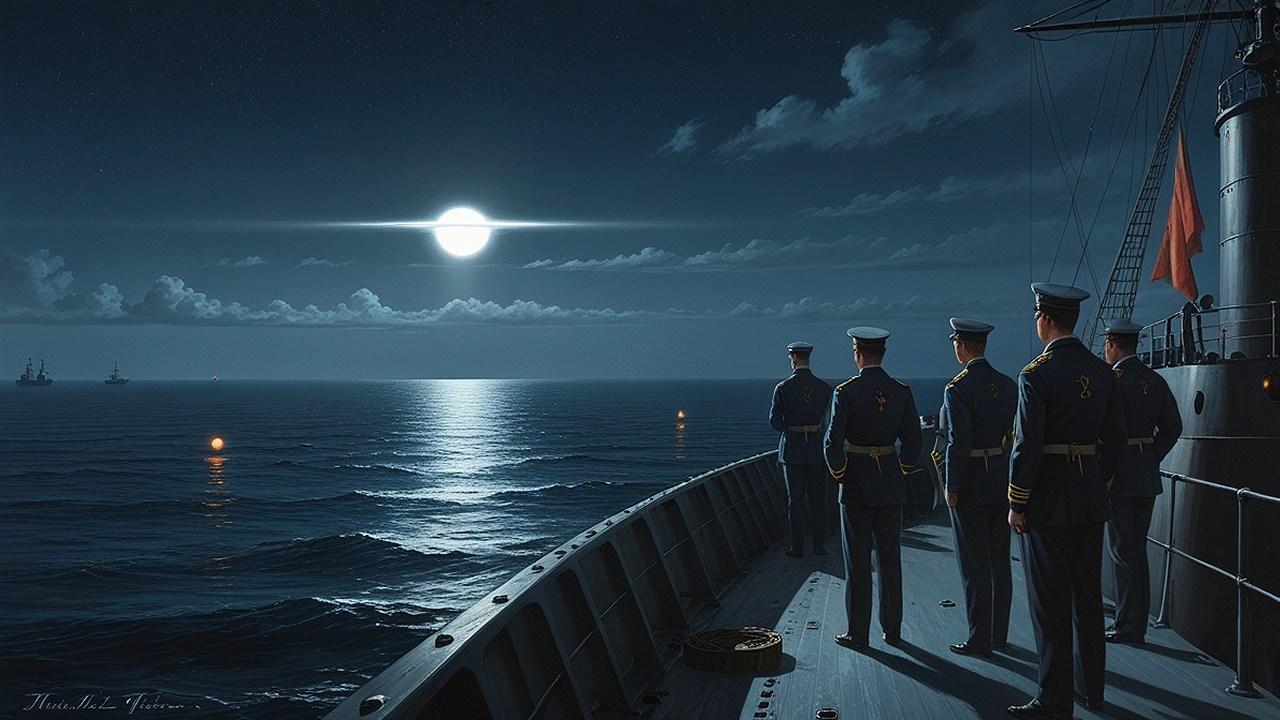
In August 1908, officers and crew aboard the U.S. Navy ship USS Justin reported an unexplainable luminous object or light phenomenon while operating in Hawaiian waters. The sighting was noted for its unusual brightness and behavior that did not match known navigational lights or natural phenomena of the era. This incident stands as one of the earliest documented military-related anomalous light reports in Hawaiian waters during the 20th century. Although brief in official records, the event provides a valuable early glimpse into the long history of unexplained aerial and luminous phenomena in the Pacific region, observed and documented by trained naval personnel.
The early 20th century marked a period of significant transition for Hawaii and the United States Navy in the Pacific. Hawaii had been annexed by the United States in 1898 and formally became a U.S. territory in 1900. The islands were rapidly becoming a strategic outpost for American naval power projection in the Pacific. Pearl Harbor was already emerging as an important coaling and repair station, and naval vessels frequently patrolled Hawaiian waters to protect American interests, conduct training exercises, and monitor maritime traffic. The USS Justin, a naval vessel active during this time, would have been part of these routine but strategically important operations. Its crew consisted of disciplined, observant sailors and officers trained to note anything unusual that could affect navigation, security, or the safety of the ship.
The sighting occurred while the USS Justin was operating in Hawaiian waters. According to available accounts, the officers and crew observed a luminous object or light phenomenon that stood out dramatically against the night sky and ocean. The light was described as unusually bright and exhibiting behavior inconsistent with standard navigational aids, such as ship lanterns, buoys, lighthouses, or celestial bodies. Witnesses noted its intensity, duration, and movement patterns, which did not align with anything familiar to experienced mariners. In the vast darkness of the Pacific at night, such a bright and anomalous light would have been impossible for a trained naval crew to overlook.
The credibility of the witnesses is a central strength of this case. Naval officers and crew members in 1908 were highly disciplined professionals. Their training emphasized accurate observation, detailed logging of events, and rapid assessment of potential threats or hazards. Unlike civilian witnesses, who might interpret phenomena through personal or cultural lenses, naval personnel approached sightings with a practical, operational mindset. They were accustomed to distinguishing between known lights—from other vessels, shore installations, or natural sources—and anything out of the ordinary. The fact that the sighting was reported collectively by officers and crew lends it additional weight, representing a shared professional observation rather than an isolated individual account.
Geographically, Hawaiian waters in 1908 offered an expansive and relatively dark observational environment. The islands’ isolation in the central Pacific meant minimal light pollution compared to mainland coastal areas. Clear nights provided long sightlines across open ocean, making luminous phenomena particularly visible. The USS Justin’s position in these waters placed it in a region where both natural and potentially anomalous events could be observed without interference from heavy coastal development. The Pacific’s dynamic atmospheric and oceanic conditions sometimes produce unusual light effects, but experienced naval crews were well-versed in recognizing such phenomena and would typically note when something deviated from known patterns.
The broader historical context of 1908 is relevant for understanding the significance of the sighting. This was the era of the Great White Fleet and expanding American naval power. The United States was asserting its presence in the Pacific following the Spanish-American War. Naval vessels like the USS Justin operated with heightened awareness of potential foreign threats and the need for accurate intelligence. In this environment, an unusual luminous object would have been logged not only out of scientific curiosity but also for operational security reasons. While no formal investigation appears to have followed publicly, the sighting’s inclusion in naval records or later compilations indicates it was considered noteworthy at the time.
The 1908 USS Justin sighting fits into a longer pattern of maritime anomalous light reports in the Pacific. Similar accounts of bright, unusual lights over ocean waters appear in 19th-century records from various Pacific routes. These often involved lights that hovered, moved independently, or exhibited behavior inconsistent with known vessels. The Hawaiian case is notable for its documentation by U.S. Navy personnel during a period of increasing American naval activity in the region. It helps establish an early 20th-century baseline for luminous phenomena in Hawaiian waters, predating the modern UFO era by nearly four decades.
Culturally and scientifically, the sighting occurred at a time when traditional Hawaiian interpretations of lights over the ocean coexisted with emerging Western scientific perspectives. In Hawaiian tradition, unusual lights at sea could be seen as manifestations of spiritual forces, ancestral guardians, or significant omens. Naval officers, trained in a more empirical tradition, would have approached the phenomenon with a focus on practical explanation. The tension between these worldviews makes the 1908 case particularly interesting as a transitional report from a period of cultural and technological change in Hawaii.
The preservation of this account, though limited in detail, demonstrates the value of military and maritime records in documenting anomalous events. Naval logs from the early 20th century occasionally noted unusual occurrences that had potential operational significance. The USS Justin sighting’s reference in later compilations of Pacific anomalies underscores its perceived importance. While the absence of extensive technical data limits modern analysis, the professional nature of the witnesses creates a compelling historical record.
In the broader context of Hawaii’s anomalous aerial history, the 1908 sighting serves as an important early marker in the 20th century. It predates the major waves of UFO reports that began in the 1940s and shows that unusual luminous phenomena were already being documented by military observers in Hawaiian waters. This helps establish continuity in the region’s history of unexplained events. Later Hawaiian cases, including strange lights in the 1930s and post-1947 UFO activity, can be viewed as part of a longer pattern rather than entirely isolated incidents. The maritime setting also connects this case to Hawaii’s identity as a seafaring culture, where the ocean has long been a realm of both practical navigation and mystery.
Modern researchers studying global UAP patterns find value in early military cases like the USS Justin sighting. They provide historical depth to discussions about luminous phenomena over ocean areas. The behavior described—unusual brightness and non-standard movement—aligns with characteristics reported in later maritime UAP cases worldwide. While the lack of instrumental data from 1908 limits definitive conclusions, the testimony of trained naval personnel creates a credible foundation for continued study.
The cultural legacy of this sighting, though subtle, contributes to Hawaii’s maritime and anomalous heritage. Stories of strange lights over Hawaiian waters have been part of local seafaring lore for generations. The 1908 case adds a documented military dimension to this tradition. In contemporary discussions of UAP in the Pacific, early naval reports like this one provide important historical context, showing that interest in unusual lights over Hawaiian waters has existed for well over a century.
The luminous object or light phenomenon observed by the officers and crew of the USS Justin in August 1908 remains one of the earliest documented military-related anomalous reports in Hawaiian waters during the 20th century. For the men aboard that naval vessel, the event was likely a memorable departure from routine operations—a moment when the familiar Pacific night revealed something unexplained. Their professional observation, preserved through naval records and later historical references, contributes significantly to Hawaii’s catalog of anomalous phenomena.
While many questions about the exact nature of the light remain unanswered due to the limitations of early 20th-century documentation, the credibility of the witnesses and the operational context ensure its place in Hawaiian anomalous history. As research into unidentified aerial and transmedium phenomena advances, cases like the 1908 USS Justin sighting provide valuable historical perspective, reminding us that the waters around the Hawaiian Islands have long hosted phenomena that challenge conventional understanding.
The strange luminous object encountered by the USS Justin in Hawaiian waters in 1908 may have eventually disappeared from view, but its place in the islands’ history endures. It stands as an early testament to the enduring enigma of anomalous lights in the Pacific and the importance of preserving accounts from those who patrolled and navigated those vast waters on behalf of the United States Navy.