


Blog Categories
- African Incidents
- Atlantis Incidents
- Australian Incidents
- Belgian Incidents
- Bermuda Triangle Incidents
- Brazilian Incidents
- Canadian Incidents
- Chinese Incidents
- European Incidents
- France Incidents
- Ghosts
- Giants
- Italy Incidents
- Japanese Incidents
- Middle East Incidents
- Portugal Incidents
- Project Serpo
- Puerto Rico Incidents
- Russian Incidents
- Sasquatch
- Scandinavia Incidents
- Spanish Incidents
- UFOs
- United Kingdom Incidents
- United States Incidents
The Fiery Sphere of 1643: Captain John Stagg
The recorded history of unidentified aerial and submerged objects stretches much further back than modern eyes usually expect. While the twentieth century is often framed as the dawn of the UFO era, the truth is that accounts of strange, luminous, intelligently moving objects have appeared throughout human history, long before powered flight, long before satellites, and long before a technological explanation was even possible.
One of the most striking examples of these early encounters—especially those involving what modern researchers classify as USOs, or unidentified submerged objects—comes from the year 1643 off the coast of Devonshire, England. The observation, documented in British naval records and associated with a Captain John Stagg, describes a fiery, silent sphere rising from the sea, disturbing the waters, generating steam, and performing maneuvers that strongly echo many later and far better-known cases.
This is the story of the 1643 Fiery Sphere — one of the earliest well-documented USO encounters on record. It shows that mysterious objects interacting with the ocean are not modern inventions, hallucinations, or aviation misidentifications. Instead, such reports have been with us for centuries. Welcome to the channel. Today we examine this remarkable seventeenth-century sighting in full detail, staying faithful to the historical record.
The year 1643 placed England squarely in the middle of the First English Civil War. The Royal Navy and merchant vessels alike navigated not only domestic conflict but also the constant threats posed by weather, piracy, and hostile European forces. Maritime recordkeeping was well developed by this time. Ship logs, naval correspondences, and officer reports were written with formal structure and care, as shipping was essential to trade, military logistics, and communication.
Captain John Stagg’s sighting near Devonshire falls squarely into this tradition. Rather than appearing in folklore or rumor, it appears in recorded naval accounts from a period when seafaring officers wrote with precision. Although the surviving details are brief, they are entirely unambiguous in describing something unusual emerging from and returning to the sea.
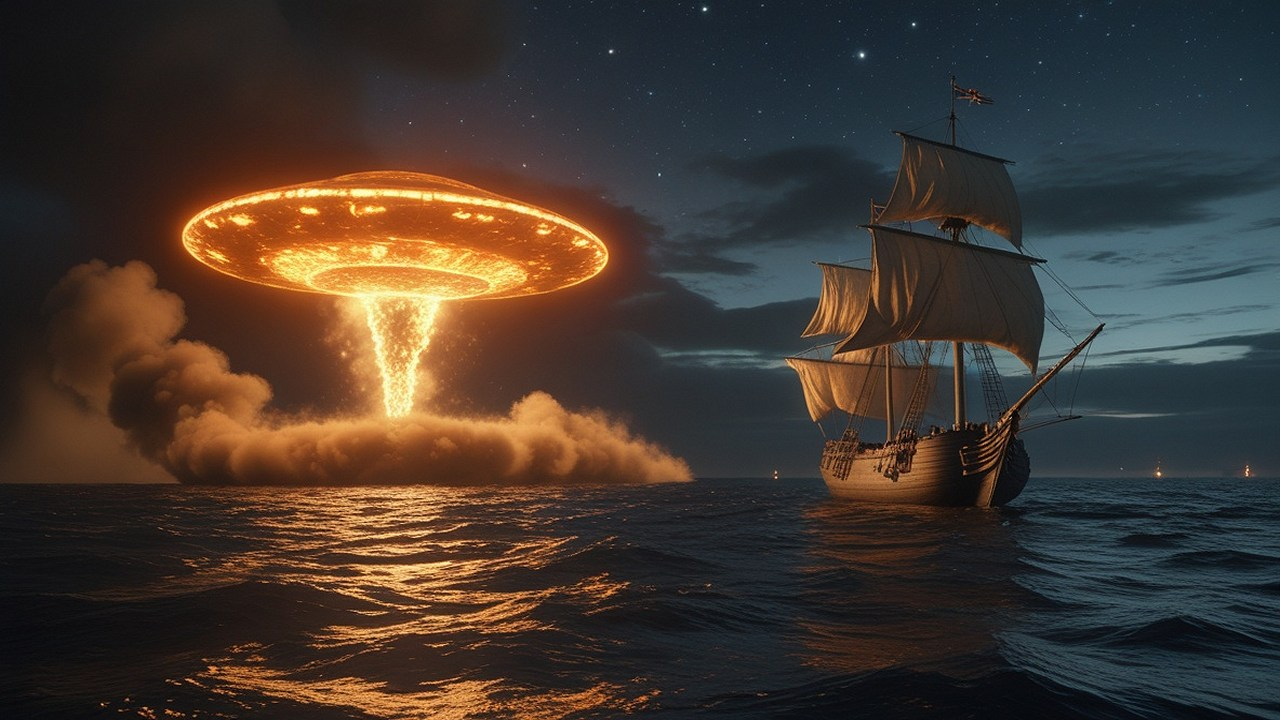
According to the record, Stagg and his crew observed a “fiery globe” rising directly from the surface of the sea. The object did not appear to descend from above, nor did it float upon the water; it originated beneath it. As it emerged, it violently disturbed the surface, causing waves and a visible updraft of vapor or steam. This detail alone—steam triggered by the object’s emergence—strongly suggests intense heat or energy output, but also indicates that the water itself was physically displaced, not simply illuminated.
Witnesses noted that the globe was fiery in appearance but silent in motion. It produced no thunderclap, roar, hissing sound, or explosive noise. Instead, it moved with a smooth, controlled, and deliberate trajectory. No wings, sails, or mechanical components were visible, nor any sign of propulsion familiar to the naval observers of the time. The behaviour was neither random nor chaotic. The sphere ascended, hovered, and re-entered the sea in a controlled manner rather than falling or crashing.
The most striking aspect is that Stagg and his crew reported the object performing this sequence multiple times: rising from the sea, hovering or darting, and plunging back beneath the waves. Each time the water reacted. Each time steam or vapor rose. Each time the object remained silent. Such repeated maneuvers effectively rule out natural explanations like atmospheric plasma, meteors, or ball lightning, which do not enter and exit water repeatedly—nor do they remain intact during such interactions.
Furthermore, the ability to produce intense heat yet maintain a coherent structure, while interacting intelligently with the environment, echoes modern USO reports in which luminous, aerodynamic objects move seamlessly between air and water without slowing or fragmenting. Captain Stagg's crew was reportedly unsettled by the encounter, but their account does not contain the panic one might expect. Instead, the description reads as a careful observation of something outside ordinary experience, something clearly technological or under intelligent control, yet utterly unknown.
Unlike today, where a sighting of this type would be analyzed through lenses of physics, aerospace engineering, and extraterrestrial hypotheses, the seventeenth century had no such conceptual framework. Atmospheric science was rudimentary. The idea of extraterrestrial life was philosophical, not scientific. And no human invention even remotely resembled the object described.
Most anomalous sightings from this era were interpreted through religious or supernatural frameworks. A fiery globe rising from the sea could be interpreted as an omen, a sign, or a manifestation of divine or demonic forces. However, Stagg’s report is conspicuously free of religious interpretation or dramatic language. It simply describes the event, leaving readers with a factual, almost clinical summary rather than a theological response.
Because the incident did not lead to catastrophe, damage, or widespread public spectacle, it did not generate a broader cultural movement or cause panic among the coastal population. Instead, it simply entered the naval record and moved into obscurity. Ordinary people likely never heard about it. At a time when shipwrecks, disease, and war dominated public concern, a mysterious globe rising from the sea would not necessarily hold the attention of a population accustomed to hardship and strange natural signs.
Still, for the officers and crew who witnessed it, the event must have carried significant weight. Seafarers were accustomed to interpreting the environment carefully. An object that behaved unlike celestial bodies, weather phenomena, or known marine hazards would have stood out as something extraordinary. Yet, lacking an explanatory framework, they could only observe without understanding.
The importance of the Stagg encounter lies not in what it changed in 1643 but in how it contributes to a long-term pattern recognized by modern researchers. Today, the sighting is frequently cited within discussions of pre-industrial USO reports. When set alongside similar cases—glowing spheres, silent luminous objects, craft emerging from or plunging into water—the consistency becomes difficult to dismiss.
Beginning in the twentieth century, naval encounters with underwater objects became increasingly common, especially among military vessels. These include high-speed sonar targets, luminous underwater craft, and objects capable of transitioning between water and air without friction. Viewed from this perspective, the 1643 incident is not an outlier—it is part of a centuries-long dataset.
Researchers note several features of the Stagg sighting that strongly align with modern USO behaviour:
It rose from beneath the water.
It exhibited controlled flight.
It emitted significant light.
It generated heat or energy, evidenced by steam.
It was silent.
It re-entered the water without destruction.
It performed multiple, deliberate maneuvers.
These traits continue to appear in documented military encounters today, often with greater technological clarity due to radar, sonar, and electronics that did not exist in the seventeenth century.
The Stagg incident is also frequently referenced when discussing the possibility that anomalous craft use oceans as operational environments—whether as transit points, entryways, hiding locations, or energy sources. The ocean is vast, largely unexplored, and far more difficult to surveil than the sky. From this perspective, a fiery sphere repeatedly entering and exiting water near Devonshire may not be a bizarre miracle—it may be an example of exactly the same behaviour documented in modern naval incidents.
Captain John Stagg himself is not a major figure of British naval history, but his presence in the historical record gives the sighting credibility. Early maritime officers bore heavy responsibility, and their logs were expected to be accurate. Any open deception or embellishment carried the risk of punishment, especially during wartime.
Although Stagg’s life is not extensively documented, his role as an officer and the formal structure of his report assure historians that the account is genuine. The absence of sensationalism, the avoidance of supernatural embellishment, and the measured tone of the record all reinforce its authenticity. The crew members, though unnamed, also matter. Observations made by multiple witnesses carry more weight than those recorded by a single individual.
Modern researchers, including those studying early maritime UFO phenomena, frequently reference the Stagg sighting as one of the earliest robust examples of a USO interacting with the environment in a manner consistent with modern reports. While not widely known, it has become a staple of serious historical UFO studies.
Today, the 1643 Stagg encounter stands as a compelling piece of long-term evidence. It demonstrates that the phenomenon—whatever its origin—was observed centuries before any technology existed that could account for it. It shows that the interaction between luminous craft and the ocean is not a novelty but a repeating pattern.
More importantly, it reveals that these objects exhibit a level of control, coherence, and intentionality that strongly suggests intelligence. This is significant because skeptics often argue that UFO sightings stem from modern anxieties, experimental aircraft, satellites, or misinterpretations of modern technologies. Events like Stagg’s remove those explanations entirely. They occurred in eras without technology, media hype, photography, or mass communication.
The sighting also reinforces the idea that oceans may play a central role in the UFO phenomenon. From ancient accounts to modern naval reports, the pattern is the same: luminous, controlled craft interacting with water, moving between mediums effortlessly, and demonstrating capabilities far beyond human engineering.
While the 1643 event did not shake the foundations of society at the time, its quiet presence in the historical record reverberates today. It provides a rare and valuable glimpse into a world where anomalous craft were present long before humans could even imagine them. Combined with similar accounts from other centuries, it strengthens the case that the phenomenon is both ancient and consistent.
In this light, Captain Stagg’s fiery sphere is not just a curious footnote. It is part of a global, multi-century narrative—one that continues to unfold, one that challenges our assumptions, and one that suggests humanity has been observing something extraordinary for far longer than we realize.
It stands as a testament to the enduring mystery beneath our oceans and above our heads, a reminder that even in the seventeenth century, sailors watched the horizon not just for storms or enemy ships, but for wonders that defied the boundaries of their world.
The recorded history of unidentified aerial and submerged objects stretches much further back than modern eyes usually expect. While the twentieth century is often framed as the dawn of the UFO era, the truth is that accounts of strange, luminous, intelligently moving objects have appeared throughout human history, long before powered flight, long before satellites, and long before a technological explanation was even possible.
One of the most striking examples of these early encounters—especially those involving what modern researchers classify as USOs, or unidentified submerged objects—comes from the year 1643 off the coast of Devonshire, England. The observation, documented in British naval records and associated with a Captain John Stagg, describes a fiery, silent sphere rising from the sea, disturbing the waters, generating steam, and performing maneuvers that strongly echo many later and far better-known cases.
This is the story of the 1643 Fiery Sphere — one of the earliest well-documented USO encounters on record. It shows that mysterious objects interacting with the ocean are not modern inventions, hallucinations, or aviation misidentifications. Instead, such reports have been with us for centuries. Welcome to the channel. Today we examine this remarkable seventeenth-century sighting in full detail, staying faithful to the historical record.
The year 1643 placed England squarely in the middle of the First English Civil War. The Royal Navy and merchant vessels alike navigated not only domestic conflict but also the constant threats posed by weather, piracy, and hostile European forces. Maritime recordkeeping was well developed by this time. Ship logs, naval correspondences, and officer reports were written with formal structure and care, as shipping was essential to trade, military logistics, and communication.
Captain John Stagg’s sighting near Devonshire falls squarely into this tradition. Rather than appearing in folklore or rumor, it appears in recorded naval accounts from a period when seafaring officers wrote with precision. Although the surviving details are brief, they are entirely unambiguous in describing something unusual emerging from and returning to the sea.
According to the record, Stagg and his crew observed a “fiery globe” rising directly from the surface of the sea. The object did not appear to descend from above, nor did it float upon the water; it originated beneath it. As it emerged, it violently disturbed the surface, causing waves and a visible updraft of vapor or steam. This detail alone—steam triggered by the object’s emergence—strongly suggests intense heat or energy output, but also indicates that the water itself was physically displaced, not simply illuminated.
Witnesses noted that the globe was fiery in appearance but silent in motion. It produced no thunderclap, roar, hissing sound, or explosive noise. Instead, it moved with a smooth, controlled, and deliberate trajectory. No wings, sails, or mechanical components were visible, nor any sign of propulsion familiar to the naval observers of the time. The behaviour was neither random nor chaotic. The sphere ascended, hovered, and re-entered the sea in a controlled manner rather than falling or crashing.
The most striking aspect is that Stagg and his crew reported the object performing this sequence multiple times: rising from the sea, hovering or darting, and plunging back beneath the waves. Each time the water reacted. Each time steam or vapor rose. Each time the object remained silent. Such repeated maneuvers effectively rule out natural explanations like atmospheric plasma, meteors, or ball lightning, which do not enter and exit water repeatedly—nor do they remain intact during such interactions.
Furthermore, the ability to produce intense heat yet maintain a coherent structure, while interacting intelligently with the environment, echoes modern USO reports in which luminous, aerodynamic objects move seamlessly between air and water without slowing or fragmenting. Captain Stagg's crew was reportedly unsettled by the encounter, but their account does not contain the panic one might expect. Instead, the description reads as a careful observation of something outside ordinary experience, something clearly technological or under intelligent control, yet utterly unknown.
Unlike today, where a sighting of this type would be analyzed through lenses of physics, aerospace engineering, and extraterrestrial hypotheses, the seventeenth century had no such conceptual framework. Atmospheric science was rudimentary. The idea of extraterrestrial life was philosophical, not scientific. And no human invention even remotely resembled the object described.
Most anomalous sightings from this era were interpreted through religious or supernatural frameworks. A fiery globe rising from the sea could be interpreted as an omen, a sign, or a manifestation of divine or demonic forces. However, Stagg’s report is conspicuously free of religious interpretation or dramatic language. It simply describes the event, leaving readers with a factual, almost clinical summary rather than a theological response.
Because the incident did not lead to catastrophe, damage, or widespread public spectacle, it did not generate a broader cultural movement or cause panic among the coastal population. Instead, it simply entered the naval record and moved into obscurity. Ordinary people likely never heard about it. At a time when shipwrecks, disease, and war dominated public concern, a mysterious globe rising from the sea would not necessarily hold the attention of a population accustomed to hardship and strange natural signs.
Still, for the officers and crew who witnessed it, the event must have carried significant weight. Seafarers were accustomed to interpreting the environment carefully. An object that behaved unlike celestial bodies, weather phenomena, or known marine hazards would have stood out as something extraordinary. Yet, lacking an explanatory framework, they could only observe without understanding.
The importance of the Stagg encounter lies not in what it changed in 1643 but in how it contributes to a long-term pattern recognized by modern researchers. Today, the sighting is frequently cited within discussions of pre-industrial USO reports. When set alongside similar cases—glowing spheres, silent luminous objects, craft emerging from or plunging into water—the consistency becomes difficult to dismiss.
Beginning in the twentieth century, naval encounters with underwater objects became increasingly common, especially among military vessels. These include high-speed sonar targets, luminous underwater craft, and objects capable of transitioning between water and air without friction. Viewed from this perspective, the 1643 incident is not an outlier—it is part of a centuries-long dataset.
Researchers note several features of the Stagg sighting that strongly align with modern USO behaviour:
It rose from beneath the water.
It exhibited controlled flight.
It emitted significant light.
It generated heat or energy, evidenced by steam.
It was silent.
It re-entered the water without destruction.
It performed multiple, deliberate maneuvers.
These traits continue to appear in documented military encounters today, often with greater technological clarity due to radar, sonar, and electronics that did not exist in the seventeenth century.
The Stagg incident is also frequently referenced when discussing the possibility that anomalous craft use oceans as operational environments—whether as transit points, entryways, hiding locations, or energy sources. The ocean is vast, largely unexplored, and far more difficult to surveil than the sky. From this perspective, a fiery sphere repeatedly entering and exiting water near Devonshire may not be a bizarre miracle—it may be an example of exactly the same behaviour documented in modern naval incidents.
Captain John Stagg himself is not a major figure of British naval history, but his presence in the historical record gives the sighting credibility. Early maritime officers bore heavy responsibility, and their logs were expected to be accurate. Any open deception or embellishment carried the risk of punishment, especially during wartime.
Although Stagg’s life is not extensively documented, his role as an officer and the formal structure of his report assure historians that the account is genuine. The absence of sensationalism, the avoidance of supernatural embellishment, and the measured tone of the record all reinforce its authenticity. The crew members, though unnamed, also matter. Observations made by multiple witnesses carry more weight than those recorded by a single individual.
Modern researchers, including those studying early maritime UFO phenomena, frequently reference the Stagg sighting as one of the earliest robust examples of a USO interacting with the environment in a manner consistent with modern reports. While not widely known, it has become a staple of serious historical UFO studies.
Today, the 1643 Stagg encounter stands as a compelling piece of long-term evidence. It demonstrates that the phenomenon—whatever its origin—was observed centuries before any technology existed that could account for it. It shows that the interaction between luminous craft and the ocean is not a novelty but a repeating pattern.
More importantly, it reveals that these objects exhibit a level of control, coherence, and intentionality that strongly suggests intelligence. This is significant because skeptics often argue that UFO sightings stem from modern anxieties, experimental aircraft, satellites, or misinterpretations of modern technologies. Events like Stagg’s remove those explanations entirely. They occurred in eras without technology, media hype, photography, or mass communication.
The sighting also reinforces the idea that oceans may play a central role in the UFO phenomenon. From ancient accounts to modern naval reports, the pattern is the same: luminous, controlled craft interacting with water, moving between mediums effortlessly, and demonstrating capabilities far beyond human engineering.
While the 1643 event did not shake the foundations of society at the time, its quiet presence in the historical record reverberates today. It provides a rare and valuable glimpse into a world where anomalous craft were present long before humans could even imagine them. Combined with similar accounts from other centuries, it strengthens the case that the phenomenon is both ancient and consistent.
In this light, Captain Stagg’s fiery sphere is not just a curious footnote. It is part of a global, multi-century narrative—one that continues to unfold, one that challenges our assumptions, and one that suggests humanity has been observing something extraordinary for far longer than we realize.
It stands as a testament to the enduring mystery beneath our oceans and above our heads, a reminder that even in the seventeenth century, sailors watched the horizon not just for storms or enemy ships, but for wonders that defied the boundaries of their world.